
Cryptocontracts Will Turn Law Into a Programming Language

A couple of weeks ago, I wrote a post with 10 things that amazed me about bitcoin (here). I just can’t stop thinking about the idea that I brought up in the final point of that post, specifically that bitcoin could enable the development of self-enforcing contracts. It is just such a huge game changer that a program could hold wealth in a way that is inaccessible to anyone, and then distribute said wealth based on defined and agreed mathematical rules.

One example I have been thinking about is that I could create a contract to support this blog, whereby readers could donate their support to the contract but I would only get paid out a certain amount (or perhaps a percentage of the total pool) for every post I make. In this way, donors would be able to give their support but also would have some form of assurances that they would continue to receive content for their donation. Additional complexity could also be used to enhance the effectiveness of such contracts; things like such as word requirements, per reader bonuses, cost recovery clauses, an expiry dates when unused money should to be returned to a donor etc.

While applying this to a blog is a rather mundane example, I can imagine this could be exactly how donation driven projects will be run in the future (such as charities, scientific foundations, maybe even governments). 

All of this got me thinking that this kind of programmatic wealth distribution is exactly what contracts already do. A lawyer draws up a piece of paper that says I am going to do A, so you will pay me B. What self-enforcing contracts change is that we no longer necessarily need a court system to arbitrate contract law, instead the contract will be mathematically predetermined and enforced by the commons of the cryptocurrency network. While I imagine that larger contracts would likely be built with some sort of failsafe mechanism for arbitration, there is no need for such a thing to exist. Would such a system be subject to gaming by the parties involved? Yes of course, but I still feel it would be an improvement on current generation contracts and would certainly leave the door open to expanding complexity necessary to close loopholes.

The twin technologies of cryptocurrencies and cryptocontracts are going to turn contract law into a programming language. 

Essentially what we are talking about is a real democratization of contractual agreements. Whereas today contracts are restricted to deals with enough value to justify a lawyers time (mortgages, business deals, land transfer etc…), in the future there is no limit to what could be codified into simple contracts. You could imagine forming a self-enforcing contract around something as simple as sharing a lawnmower with your neighbor, hiring a babysitter, or forming a gourmet coffee club at work. Where this could really revolutionize things is in developing nations, where the ability to exchange small-scale microloans with self-enforcing contractual agreements that come at little or no cost would be a quantum leap forward.

For more exotic examples, I was thinking of what could come if such contracts were combined with the ubiquity of data tracking today. In my example above, you could set up a contract with my blog to transfer a micropayment to support the blog every time you refer to an idea you found on my blog. Similar payment contracts could be set up for knowledge archives like wikipedia where you might agree to submit a micropayment every time you use or reference information from the site.

If we combine self-enforcing contracts with the idea of biological data tracking then things could get really wild. Imagine that you are carrying a cell phone which measures your emotional state. You then enter a contract with an entertainment company to pay them a certain amount based on the intensity of emotion which you experience during the movie or video game you are using. Suddenly you would be no longer only figuratively buying an emotional experience when you purchase something, but you are directly incentivizing emotional payout based on a self-enforcing contract. 

At every level our lives are built around spoken and unspoken agreements, yet the codification of a contractual agreement has been relegated to only the most important and expensive transactions. The emergence of cheap and plentiful self-enforcing contracts means that we can codify simple transactions and agreements. We will be able to reprogram our lives based on self-enforcing cryptocontracts. 

The coming boom in cryptocontracts comes with its own risks as well. In a world where self enforced contracts will be an everyday occurrence, we must be much more careful clicking on those terms of service agreements which nobody reads. We are going to need to be well aware of what it is we are giving away. Similarly, we must each decide what we want to codify in our own lives. Although it may be possible, it may not be wise to establish contractual arrangements around romantic or family relationships.

Ultimately, cryptocontracts will offer us a revolutionary new way to rebuild and reorganize our lives and our societies from the bottom up.

Edit: For those interested in the technology discussed here, I encourage you to check out the Ethereum project, which is working on developing a computing language to run these types of contracts on a cryptocurrency backbone. 

Edit2: I have been reading some of the comments on sites linking this article and I want to clear up one common confusion. The key difference between a cryptocontract and a standard contract is that the contract can itself hold wealth in the form of crytocurrency. All contracting parties can see the format of the contract and agree on its content, but the use of cryptography means nobody has access to the funds until the program moves it in accordance with the guidelines agreed. Another point is that these contracts could easily implement a clause for exception handling in the form of some form of court or other 3rd party mediation. 

UPDATE: Openbazaar is another project doing some very interesting work in this area. They are trying to create an open and distributed marketplace which leverages the power of cryptocurrency and reputation networks to handle dispute resolution without a central authority. A very exciting and interesting project, and definitely worth checking out over at https://openbazaar.org/
Humans, Horses and the Arc of Economic Obsolescence

I watched a great talk from Andrew McAfee and Erik Brynjolfsson this week. For a few years now these two have been evangelizing about the coming automation revolution that now seems to be given to wider discussion if not yet acceptance.

In their second book, The Second Machine Age, Brynjolfsson and McAfee return to their diagnosis of extreme economic disruption due to increasing automation in the manufacturing and service industries. I have yet to pick up the book myself, but after watching their Google talk I am sure to do so in the very near future. 

In their presentation, they reference some surprising statistics, including that the number of people employed by the manufacturing industry in China has actually decreased in recent years. As automation starts to really accelerate in the manufacturing sector, this might mean that developing economies potentially have much higher exposure to associated economic disruption. What it will mean for the steady climb of the world’s poor if they lose access to the lower rungs of the economic ladder remains to be seen, but it seems entirely possible that automation could lead to serious problems for places like Bangladesh.

The most fascinating thing that I think the two brought up was a very apt comparison of human workers to horses. A hundred years ago, a horse was a very important economic unit. In 1900, if I offered to lease my horse to almost any business owner for a reasonable price, they would have likely taken me up on the deal because they could do a lot of stuff with a horse. They could transport themselves to work, they could deliver goods to market, they could plow a field, or they could sub-lease the horse out to do any of these jobs for other people. Horses used to be useful and profitable.

But if you were to take your horse to most any business person today, even if you offered the horse to them for free, you would probably get laughed out of the building. What the hell am I supposed to do with a horse? This would almost certainly be their response for the simple reason that horses are no longer economically useful. Machines have replaced horses so perfectly that the cost to train, feed and house a horse greatly outweighs their economic benefit. Outside of a few niche nostalgic industries, horses are economically obsolete

So this of course begs the question, are human workers going to become like the horse? Of course there will be an economically productive place for exceptional people for the foreseeable future (just as there is for exceptional horses), but the question is really about the average worker.  Will we soon get to a point where automation is so cheap and so effective that the cost to train, feed and house an average worker will outweigh the economic benefit that can be derived from them. 

McAfee says that he and Brynjolfsson have had heated discussions about this very issue, but generally they are still not sure whether we are headed to a future where average workers are economically obsolete. To me it is scary how clear the conclusion is. Yes, human workers are just like horses, we are already on the arc of economic obsolescence and we have been for some time. 

There is a simple example that makes me so sure that average workers are slowly falling behind their economic benefit — children. Children used to be a clear economic benefit to their parents. They could be easily put to work doing any of the countless menial tasks associated with an agricultural economy, such as plowing fields, harvesting crops, milking cows and churning butter. Children were economically beneficial, and people responded to this by having lots of them.

But, as the first industrial revolution started making it easier and cheaper to use machines to produce food, a huge number of workers migrated to the city looking for work. In the cities, children lacked the strength, fine motor skills and education that was necessary for them to be really useful in the factory economy. Suddenly, children went from an economic benefit to an economic liability. The cost to train, feed and house a child greatly outweighed their economic benefit, and parents responded by having far fewer of them.

People responding to this change from children being an economic benefit to a cost is a story that has played out over and over again across the world. The economic disincentive to child-bearing has been the single most important factor in the falling fertility rates across the globe. This change is so complete that we are now in a world where the overall average number of children per woman is only 2.5 (see this excellent talk by Hans Rosling and the BBC).

It is a striking fact that the transition of human children to economic obsolescence has been so complete the worldwide birthrate already stands barely above replacement numbers. And in more recent times, I think obsolescence extends well beyond just children. Only a couple of decades ago, an 18-year-old with only a basic education was still of fair economic value. They could get a job in a small business or in a factory and likely be of good economic value to the business owner; at least their value was more than enough for them to survive on. Nowadays this no longer seems to be true, a point reflected in the fact that minimum wage generally falls close to or below the amount of money which is really needed to train, feed and house an average person. We already live in a world where the economic benefit of an average untrained individual is falling behind their maintenance costs. 

The creeping arc of economic obsolescence may not stop at uneducated 18-year-olds either. The economic downturn hit young people disproportionately harder than the older population of established workers, and it seems that for youth around the world the recession is not yet over. So many grads, even with good post-secondary educations are unable to find productive employment, and are increasingly showing their agitation at this fact. Economists point to complex macroeconomic changes as the reason behind inflated youth unemployment, but maybe it is simpler than that. Perhaps on the wider scale, the costs of hiring new employees simply outweighs their economic benefit; maybe we are just experiencing the early symptoms of the arc of economic obsolescence reaching the level of the average educated worker.

Of course businesses need to hire some new people, but it only takes a small shift in the balance between the available pool of workers and the number of jobs openings to remove the pressure to offer competitive wages and benefits. All of this, and the automation revolution has not yet even started. Where are we going to be in five to ten years when every call center is automatedcars can drive themselves, and computers are consulting on medical disagnosis?

At the end of their talk, Brynjolfsson and McAfee offer some possible prescriptions for the automation revolution that they predict will hit over the next decade. They offer options such as a negative income tax, which would subsidize workers at the bottom of the pay scale who offer the least economic value. While the institution of a negative income tax or a basic income (a better option in my opinion) might go a long way to easing the effects of high structural unemployment, the problem with this might be summed up by a criticism McAfee himself delivers: What if this is a linear solution to an exponential problem?

When the horses went from benefit to cost, I am sure that the transition was not nice for those who worked in the industries which supported horses (let alone for the horses themselves). I am not optimistic that the transition of the average human worker from economic benefit to cost is going to be any nicer. As our baked-in beliefs about the value of work are increasingly at odds with our economic realities, I think things are going to get much worse before they get better. The social support systems that we now have in place, such as welfare, pensions and unemployment insurance are far to weak to deal with the extreme economic disruption that will be delivered by automation. Add to this the fact that much of the world has no such systems at all, and you can see how precarious our situation is.

It may not be today, and it may not be tomorrow, but sometime soon we will be facing unacceptable rates of unemployment, knock-on damage to the consumer economy, and significant outrage like that already happening in Spain and Greece. People will not wake up and realize how completely the game has changed until they can hear the noise. Put simply, whether we are talking about humans or horses the economic system places no intrinsic value in individuals beyond what work they can do. If a machine can do what you do cheaper and more efficiently, then it will.

Still, I must end by saying that we should not start smashing the looms; the great economic benefit of automation will ultimately outweigh its costs. Automation is going to offer untold economic surplus, but we must take that surplus and turn it towards creating a more humane system. Unless we find a means to institutionalize a basic humanity into our economic systems we will find that more and more of us are just being put out to pasture. 

“On the Blockchain Nobody Knows You’re a Fridge” and 9 Other Amazing Things About Bitcoin

All credit to a brilliant interview with Richard Gendal Brown for the quote I used in my title.

For the last several months I have been swept up with many others in the Bitcoin craze. Unfortunately, it seems that I am arriving somewhat late to this particular party, as the Bitcoin value has already gone from less than $20 to over $1000 in just one year. It would seem that people have accepted, at least for the time being, that a limited supply of purely digital money represents a legitimate store of value.

With a total store of wealth at over 8 billion dollars, the value of Bitcoin today is at least partially driven by speculators looking to cash in on the rise of the currency. Nonetheless, the importance of the technology that underlies Bitcoin and its value to society is anything but speculation. Bitcoin as a technology is deeply transformative, and stands next to other great innovations of the digital age like email or HTML (read: the web). As a currency, Bitcoin may soon become is becoming the first global currency, but this may be just the tip of the iceberg. The invention of a distributed cryptocurrency is nothing short of a revolution and it is going to change your life in ways you cannot yet even imagine. 

Here are some amazing things about Bitcoin:

1. Bitcoin is simple.

While it is an amazing technological innovation, the idea of Bitcoin is actually beautifully simple. The basic idea is that Bitcoins are sealed within a unique cryptographic locker (private key) located at a unique address within a constantly updating public ledger of transactions (known as the Blockchain). 

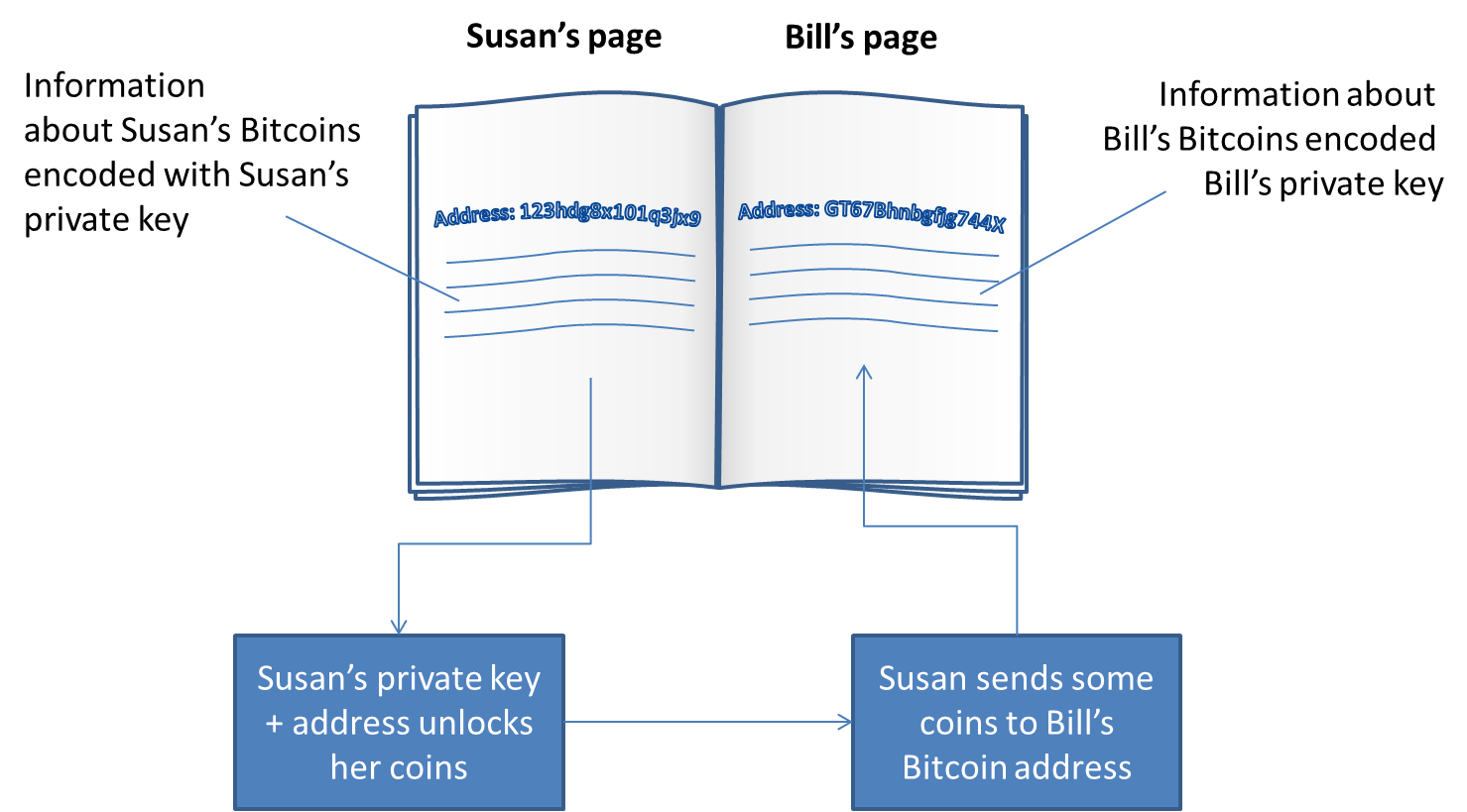
Imagine a book which records who holds every single bitcoin at any given time, but each page of the book is written with its own encryption. In order to spend their Bitcoins, a user must have their cryptographic key to unlock their Bitcoins from their page in the Blockchain. You could then send the ledger out to all of your friends so that you all have a copy of everyone’s encrypted information, but nobody will be able to change anyone else’s data without access to their individual key.  

The Blockchain

(Disclaimer: This is an extreme oversimplification of how Bitcoin works and is meant only as an explanatory tool. In order to truly appreciate the magic of Bitcoin I encourage you to listen to someone much more familar with the subject than me – see here for a great crash course on the subject.)

2. Bitcoin is secure. 

As people trade their Bitcoins for whatever reason, they must use their private keys to unlock their Bitcoins and send them to a different address on the Blockchain.  In the example above, say Susan wants to buy a pizza from Bill, she can use her private key to send Bitcoins from her Bitcoin address to Bill’s Bitcoin address. At this point the information on Bill’s address can be updated to include the new Bitcoins, which cannot be transferred from Bill’s account until Bill uses his private key to do so. Even with very powerful computers there is no feasible means that a traditional computer can crack the encryption on any Bitcoin address. Once associated with a particular public addess, it is effectively impossible to move Bitcoins without their specific private key. 

3. Bitcoin is a distributed network.

A huge network of computers all around the world is constantly working to update the information on the Blockchain. In addition to this, the computers within the network also all check that all the new transactions on the Blockchain are indeed legitimate. Every 10 minutes the entire Blockchain is updated with the new transactions that have occurred and a new master state of accounts is set. 

In exchange for doing the computational work necessary to confirm the Blockchain, owners of these computers are rewarded with newly minted Bitcoins. This provides the incentive for the network to support itself and grow to meet the demand for Bitcoin transactions. The genius of Bitcoin lies in its ability to distribute trust across an entire network.  Because the Blockchain is simultaneously being confirmed by everyone across the entire network, there is no ability for one person or group of persons to falsify the public ledger. Thus, there is no need for a single trusted third-party to confirm everyone is acting in a fair manner.

4. Bitcoin is predictable.

The rate at which new Bitcoins are created is set according to the protocol. Over time the rate of production will slow, and eventually stop at 21 million coins. There will never be more than 21 million coins. Until the number of 21 million is reached, a decreasing number of coins will be minted by the network. The predictability of Bitcoin means that people can know exactly how many will be available at any given time, and can predict how this will affect their value over time.

5. Bitcoin is valuable.

Bitcoin is worth whatever the market says it is. While this is actually the case for all currencies, we often do not think of them this way. In reality, all currencies work this way. You can hold onto your dollar as long as you want, or ask to exchange your dollar for whatever goods you think that dollar should be worth. When we distribute that idea of value across an entire market, a consensus value emerges, and this is what the currency is worth. It is not clear what Bitcoin should be worth yet, but given its utility as a means of exchange across the world, that there is a limited supply, and that it is inherently predictable, it is likely that Bitcoin and/or similar cryptocurrencies will grow singificantly in importance and value over time.

6. Bitcoin is (almost) frictionless.

While there are small transaction costs built into the Bitcoin system , the cost is much smaller than that which is charged by other transaction systems, such as paypal, banks, or wire transfer companies. The transaction cost of a Bitcoin transaction is also a flat amount, so no matter what the size of the transaction, there is a similar cost (currently around the equivalent of 10 cents). Combining the very low cost of transactions with the high speed of transactions, Bitcoin offers an almost frictionless medium for the movement of value from one place to another.

7. Bitcoin is international

Value is a complex and inherently difficult thing to determine. How much is a glass of water worth? It depends on how thirsty you are. Similarly, the value of Bitcoin is not yet clear but if we look to those who are most thirsty for this kind of innovation it may be those living in developing nations who do not already have access to banks who will lead the charge towards the uptake of cryptocurrencies in the coming years. The power of a savings account which your local governement cannot reach (or inflate out of value) is of great worth to people who have never had one.

8. Anything can hold Bitcoin.

Because Bitcoin is simply a cryptographic protocol to associate a unit of digital wealth with a particular address on the Blockchain, anything that can hold the public and private keys can hold Bitcoin. This means that anything that can store the 256 bits of the private key (about 64 alphanumeric characters) and the 160 bits of the public address can store Bitcoins. A text file, a piece of paper, a coin, a stone tablet, you could even write it out on beach sand – literally almost anything can hold Bitcoin. Anyone who then has the public address for that Bitcoin account can send Bitcoins into it, so in this way Bitcoin allows you to send wealth directly into anything.

9. Anything that can send data can send Bitcoin.

Anything that is connected to the web can theoretically hold and trade bitcoins. In this way, it could be possible for your fridge to hold a certain amount of bitcoin and then trade for services. For instance, when you run out of groceries your internet enabled fridge could search the internet for the best price on milk, negotiate a deal, send Bitcoins to the local grocer, and have the milk delivered all without the need for your involvement, except maybe to put the milk into the fridge when it gets there.

While the example of the fridge buying your milk for you using Bitcoin might seem like a kind of a silly example but the fact that machines can directly trade value quickly opens up more exotic possibilities. One could imagine an autonomous car which drives around picking up passengers, charging them for its services, purchasing electricity to charge itself, bringing itself in for servicing, all using Bitcoin. This kind of automated car could theoretically accrue wealth over time with little or even no human involvement.

10. Cryptocurrencies could enable self enforcing cryptocontracts

Given that cryptocurrencies like Bitcoin create a means to transmit wealth based entirely on the transmission of data with almost no friction, this opens the opportunity to create self-enforcing contracts. The simplest example would be an escrow contract, wherein money is held in a contract between two parties until both agree the money, or some proportion thereof, should go either to one or the other person. In this way, the money would not be accessible to either party until an agreement can be reached, again with little or no transactional cost for either party.

Another simple example would be an insurance type of contract, wherein if a certain weather event occurs, say a snowfall of over 20 inches was predicted by 3 weather agencies, then an automatic payout could be made to a plow company. Another example would be a contract to pay an employee or contractor or a certain amount of money for achieving a set deliverable (such as increasing sales or web traffic).

These kinds of self-enforcing contracts would not be very different from what we have today, with the exception that they would be automatically enforced by the rules established in the contract. There could be clauses instated into the contract to allow arbitration through a certain legal system, but there is no implicit need for this.

When one really starts to contemplate what could be done with cryptocurrency based contractual agreements that can physically hold funds, and distribute them according to a mathematically defined set of rules could truly revolutionize every facet of our lives. These kinds of programmable applications of cryptocurrency may go beyond what Bitcoin is alone capable of, and is being pursued in the exiting new Ethereum project.

So what is most exciting about cryptocurrencies? The answer to this is almost certainly something that we have not yet even thought of, and this is why I can’t help but get more excited for the future of cryptocurrencies every day. In a world where it often seems impossible to find anything on which we can all agree, Bitcoin has found a way to distill value directly from that one thing on which we must agree, mathematics. 

The Future Will Belong to Those Who Can See It

Let’s face it, capital is winning. (watch this video if you haven’t already seen it)

The statistics show that the game of growing capital has been getting easier over the years, whereas that other game of finding a good career and slowly accruing wealth through honest labor seems to be only getting harder. The millenials are the best educated generation ever, yet their prospects for career security and wealth accumulation seem to be only getting worse. The baby-boomers love to poke fun of the younger generations, but seem oblivious to the fact that the game is rigged in favor of those with healthy investment accounts and against those looking to build new ones. 

Yes, it seems that now is a good time to make money if you already have money, and a bad time for making money if you don’t already have some. More importantly though, I do not see any likely shift away from this trend in the near or even medium term. In a future (present?), where the magic of automation allows wealth to be directly transmuted into productive capacity with a diminishing requirement to acquire human labor, I see no likely shift in the imbalanced advantage of capital over labor.

In the future there will be owners and there will be losers. 

Even if strong new social policies such as basic income become adopted, and I am very much optimistic that these kinds of programs should and will be adopted widely in the coming decades, I am not so optimistic to believe that they will be adequate to address the accelerating wealth gap. Ironically, basic income could actually serve to impede the biggest threat to the capital class, the ability of lower classes to accrue and grow their own capital investments. 

At its core, basic income is mostly envisioned as an economic mechanism to establish an absolute floor for the social safety net. Where exactly we decide to install that floor is a matter for debate, but it seems most believe that in order to maintain an incentive for work and entrepreneurship, basic income should be set close to subsistence levels. Enough should be provided for people to eat, clothe, and house themselves, but basic income is not likely to leave a great deal for savings.

Even if basic income exceeds this “basic” mandate and does provide more than enough funds for families to enjoy a comfortable life, it still provides no incentive for people to save. If people know that they can rely for the long term on a steady basic income every month, then those people may see no reason to save much money. Why would I save for retirement if I can be assured of receiving an adequate amount to meet my needs for the rest of my life?

Of course, there will always be some percentage of individuals who will have the foresight to save as much as they can, but I would simply suggest that this percentage might actually be smaller under a regime of basic income. The psychology of foresight might be the single greatest factor which differentiates the most successful individuals in life, there is no reason to think that basic income would change this in any way. Other tools such as education should be used to encourage people to have more foresight about their lives and make better long term decisions (but that is for another post).

So what is to be done about this?  Ultimately, I think that the long-term emergence of powerful technologies such as strong artificial intelligence and molecular-scale manufacturing will eventually make individual wealth somewhat irrelevant. For the medium-term however, without the total collapse of the capitalist system, something that I believe would be too painful to suffer through no matter what the ends, I do not see any likely end to the acceleration of wealth inequity. For the next two decades, people who own things will do well and everyone else will get by. 

Still, the message of the accelerating value of capital is not entirely doom and gloom. Yes, those who control huge sums of the world’s wealthy will benefit disproportionately from the automation revolution, but the more important disparity might actually be between those who can see the future and those who cannot. If your parents can’t understand how to use their email, how could they hope to make sound investment decisions in a world revolving around technological innovation? Similarly, those wealthy individuals who are heavily invested in the successful industries of today, may lack the maneuverability to respond to the kinds of disruptive technological innovations we are seeing with increasing frequency. 

So, perhaps the most important question is not how much you have to invest, but how well you can predict the coming landscape of innovation? Being able to predict which technologies are going to be successful has been of immeasurable value since the inception of the market. Despite its ebb and flow over the years, a balanced investment in technology companies over the last 30 years would have provided unprecedented gains. I expect that the future-smart investor can realize similar gains in even shorter time over the next few years.

So however meager your savings might be, do not despair. Invest what you can, because those of us in the technology generations, who understand technology better than the rest, stand to reap enormous gains. Those who can see the future and invest in it are going to be well positioned to join the capital classes in the coming years. As the old saying goes, if you can’t beat ’em, join ’em. 

The future is going to belong to those who can see it. 

Computation is Power

The most important paradigm of power in the world today is computation.

For a long time we have heard that computers are going to revolutionize every aspect of our lives, but only recently in seeing the accelerating speed with which the personal computer, the internet, and the smartphone have revolutionized our lives have the majority of people come to see the rising tide of technological change.

Nonetheless, even as peck away at magical little devices in the palms of our hands, even as we feel the water around our feet we still think we are safe on dry land. We stare out at a rising ocean of possibility, yet we need to believe that our world is solid, that it is more or less the same as it has always been. Computers are neat, but ultimately old paradigms of power like military strength, business, politics, and money still rule the world, right?

The ability to perform computation has become the most important nexus of power in the 21st century. In the same way that power in earlier centuries was determined by who had control of key natural resources like gold or oil, power in the 21st century will be determined by whoever has the best access to computation and the accouterments that enable it, such as networking. In the modern age it is he who wields the most computation who will have the competitive edge, in war, in business, and in politics.

Put simply, computation is power.

Envisioning what a full-scale war effort between fully modernized states might look like provides the perfect example to consider the importance of computation.

Imagine the economic damage that could be done by interrupting the ability of an enemy to send money electronically from one place to another, or if you were to shut down enemy telecommunications networks. Digital attacks could be used against key infrastructure, such as electrical generating facilities or specific factories which are producing weapons. Even if these facilities are not directly connected to the internet, they could be vulnerable to more creative kinds of attacks (see the Stuxnet virus which traveled on USB drives to access Iranian nuclear production facilities in 2010).

Ultimately the question of how devastating a cyber attack could be on a modern nation can be answered with a specific question: How devastating would an extended interruption of internet communications be to you? How well would you cope if you had no access to your smart phone, email, or computer for a couple of days? a week? a month?

Clearly, cyber warfare is a combat space which suddenly just is as important as the land, air, or sea but the ability to wage such warfare in this day and age is really more about the talent of hackers involved in your cyber warfare program than about raw computation. So, we must go deeper to answer the question as to how raw computation could translate into military power.

The most obvious answer here is that raw computation opens up avenues for code-breaking that would enable more advanced forms of cyber warfare. In addition to this though, there are more exotic possibilities which could be opened up by the application of big data and massive computation leveraged against an enemy state. If you can understand your enemy better, you can predict what your enemy is likely to do.

For instance, you could analyze based on satellite data how much activity is happening at various resource collection sites and factories and estimate what kind of weapons systems your enemy is increasing production of. Similar big data analytics could tell you how happy the populace is based on how busy their cities are, how much food supplies they have, or any number of other metrics which give important insight to the operation of an enemy economy.

Big data and big computation could also be leveraged in more subtle ways against an enemy. The use of algorithmic propaganda to massage the public mood and political support for the war could be a real game changer. Using algorithms to massage the flow of information from news sites to various to individuals could be used a foment uprisings in one part of a country or depressing people’s interest in the war in other parts.

Known as micro-targeting, this kind of highly targeted campaigning has been used to push individuals in one direction or the other during political campaigns. At this point the technique of micro-targeting is still in its infancy, but as big data and big computation starts to come to bear in the micro-targeting industry this could start to represent a real super-weapon of sorts. Whether used on an enemy nation or on the people at home, an algorithm which can understand how to subtly manipulate people’s political views will offer unprecedented power for those who can control it. 

In the world of business, computational power is already providing the same kinds of advantages that it will in war or in politics. Ask any salesman, and they will tell you that it is just as important to understand your customer as it is to understand your product. You can sell anything to someone who you understand. With the reams of data which we pump into Google and Facebook every day, the companies which can turn data into successful sales models are already the ones reaping the profits, and this trend will only continue on into the future.

Just as in war, businesses might also bring computational power to bear against enemy corporations. For instance, a company which has access to the information necessary to predict the who might be the most effective employees in a rival company could orchestrate a campaign of employee poaching aimed specifically at disruption of their rival. They could also attempt to interrupt supply chains, or devise a counter-marketing strategy to specifically target individuals likely to purchase from their competitor.

The fact is that it is not difficult to conjure up countless ways in which big data can combine with powerful computation to produce new strategies in any discipline or field. Computation means power in the 21st century because it is through computation that we can better understand the world. It could be argued that computation has always been the dominant paradigm of power since the emergence of higher animals. The ability to recognize patterns and make somewhat accurate predictions about what is going to happen in a given situation is what gave rise to increasing brain size. It’s been survival of the smartest since the very beginning.

In today’s world, as machine learning advances in leaps and bounds and big data pours out like an open tap, it is those with the best computers who will best understand the world… and control it. 

The Danger of Darwinian Overdose: Why Evolutionary Innovation Requires Surplus

In this age of what seems to be an eternal economic recovery, I seem to hear a lot about how important the idea of austerity is. We must be reserved, we must make hard decisions, we must be selective. Somehow if we cut deep enough, we will come through with an efficient machine, ready to power us into the next golden age of innovation and economic plenty.

This belief that only through maximizing selective pressure can we maximize economic growth reaches its harshest heights when it filters down to the level of individual workers. There are plenty who seem to genuinely believe that if we just let the people starve a bit more, if we take away what few social benefits they have, then they’ll really have that hunger that is going to drive them to find a job and push the economy forward.

The view that maximizing selective pressure makes for the best economic evolution is often justified through comparisons to the law of natural evolution. This view that the best and brightest evolve from the primordial soup stems through a process of maximal selective pressure stems from an incomplete view of the nature of evolution.

The fact is that evolution is not some cold algorithm seeking to maximize efficiency of resource utilization through mutation and survival of the fittest. Biological adaptation is a breathtaking flourishing of possibility that requires not only resource limited selection but also needs ecological surplus. Species must flourish in a supportive and strong ecosystem to have the chance to mutate and create new forms. Species that have no established niche in which to flourish have no chance of adapting to new environments through evolutionary innovation.

Natural selection is the product of both limited resources and surplus ones. It is in thriving, healthy, ecosystems such as in the rain forests of the world where nature best explores the boundaries of possibility. Indeed, the great explosions of biological differentiation always come as great surpluses of new resources are discovered., as occurred in the rapid phases of colonization of the land by insects, then by dinosaurs, and eventually mammals.

Nature can even be downright wasteful at times. Examples like the peacock tail or antlers are great examples of the kind of beautiful adaptations that prove that nature is not some utilitarian algorithm seeking to maximize efficiency. We humans also have ecological surplus to thank for some of our best traits. The human breasts are actually the direct equivalent of the peacock’s tail, providing no real utilitarian benefit yet remaining as a strong sexual selection trait. The results are energetically wasteful yet undeniably alluring and beautiful.

Humans also have another energetically costly lump of fat which is thought to have evolved as a consequence of ecological surplus. New theories suggest that humans were able to evolve such ridiculously large brains (per body size) only after we discovered a readily available source of protein rich food in the form of fish found in coastal regions. Fascinatingly, it has also been suggested that this period of semi-aquatic existence may have also lead to the loss of fur in our ancestors (see the Aquatic Ape Hypothesis).

The view that evolution is strictly about species living on the edge of survival and competing for a limited pool of resources is a dangerous oversimplification. The fact is that the evolution of all of the wonderful forms of life around us is a product of surplus as is it of selection. 

Nature innovates best when it has space to do so; we should seek to apply the same thinking to economics.

I deeply believe that economic innovation lives by the same rules as natural selection. Yes, we must have selective pressure to allow the best and brightest to flourish, but we must also have a situation of surplus where we can allow people to experiment with new ideas, whether it be in the sphere of business, culture, education, philosophy or any other discipline that has been so vital to our economic advancement.

The politics of neo-darwinism say that we maximize innovation by maximizing the pressure on workers to innovate means to create value for the economy. But isn’t it already clear that this is not the case. How could we have innovation without having the time to educate ourselves or the capital to empower our business ideas. It is no wonder that innovations have always come predominantly from the middle and upper class where they are afforded the economic breathing room to experiment with new ideas.

We need surplus in our lives in order to power the mutational process of economic innovation.

Now, I should point out that I do not believe that we are ready to turn our backs on the market all together. Just as nature needs a balance of selective pressure and resource surplus in order to maximize evolutionary innovation, I believe that if we can find the better balance between selection and surplus then we will be better able to power economic innovation. 

In pursuit of this balance, I have come to believe that it is time that governments of the world take hold of the idea of a basic income to power the next great wave of invention that will push our economies forward. Basic income means basic freedom for all men, and it is this basic freedom to turn away from dead-end jobs and wasted lives that people need to power their innovation. Yes, jobs must continue to exist, but it is no longer economically efficient to force people into unsatisfying work simply to meet their basic needs.

The fact is that I think that economic darwinists have it backwards. Whereas they seem to think that a strong society can only come from a strong economy, but I think that a strong and free society will necessarily lead to a strong economy. If we seek to first build a better society, then we will also build a better economy.

Smoking Jackets – Part 3 of Isaac’s Escape

This is a work in progress for the next part of Isaac’s Escape. I wasn’t able to finish it in time for this week’s blog post, so I thought I would post it as I am working on it. After all, in the spirit of Futurism, this blog is always a work in progress. Go here for the first and here for the second parts.

————

Opulent wafts of tobacco smoke and expensive scotch were gradually filling the wood lined room. The cliched scene was an affectation more intoxicating than the drinks in their hands. Every detail carefully curated from old movies and pictures to perfectly reflect the image of influence and control. 

The men were laughing through teeth clenched around thick cigars. It was a night to toast old schemes, and to hatch new ones.

The haughty laughter gave way to puffs of cigar smoke and a deep sigh. The stars the in the window seemed to subtly intensify, an artificially brightened andromeda galaxy looked to be filling half of the sky above the quiet hills.

“I really can’t believe it worked” said one man as he shook his head slowly from side to side, “the sheer complexity of it”

The older man looked back with a thoughtfully furrowed brow at the other man, studying his perfectly symmetrical face with the strong but not too strong jaw and bright intelligent eyes. He looked back at him for a long time before beginning to answer.

“When you see the dominoes in place, all the way from one end of of succession to the other, is it not unsurprising when they fall together?”

“But we are not talking about dominoes here, the scale of the plan makes it inherently unpredictable”

“Au contraire, the scale of the plan is exactly what makes it so predictable! At the subatomic level the world might be random, but we need only zoom out a few orders of magnitude and things become entirely predictable.”

“Take this glass of scotch for instance,” he said holding out the glass and swirling it slowly, “we might not be able to predict the random swirls of water and alcohol as the ice melts, but knowing the temperature of the room and the properties of the glass we can predict exactly how long the ice will keep my scotch cold. Scale means predictability.”

“And what is true for my glass of scotch here, indeed holds true for society. We might not be able to predict the random swirling of ideas through individual human minds, but with adequate data and computation we can predict with a high degree of certainty how society is going to react.”

The other man nodded in agreement.

“The first thing we needed was to build our war chest of reputation resources. We developed the Reputation MinerTM platform by combining a consumer fulfillment database we acquired from the remnants of some e-commerce company with our news delivery operations. By delivering news and information with customized skewing to meet peoples expectations, Reputation MinerTM capitalizes on confirmation bias to earn peoples trust.”

“Using RM, we were able to slowly build support for our legislative agenda. We quietly lobbied to allow the election of artificial intelligence to positions throughout the government. Over just a few years, our intelligence agents proved their worth to the people by providing efficient administration of basic governmental functions, such as low level arbitration and the deployment of new transport infrastructure.”

“Backed by our RM platform and the fact that every government service that was run by AI was better and more efficient, we were able to quickly swell public support for our governmental artificial intelligence agents. Thus, last year we planted the seed of the idea that AIs should be allowed to run for congress”

The other man smirked, “I remember the headlines for the editorials: Let’s Make Politics Intelligent, or Time to Trim the Fat

“Yes, it was not a difficult sell to make the public see the benefits of an artificial intelligence agent as a politician.”

“And now here we stand, the first artificial intelligence to be elected to congress will be sworn in tomorrow. What an achievement.” said the man with a gleam of awe in his eyes.

“Pah, nothing” grunted the old man, “merely another domino”

“Will you aim to replace the president in two years? Or perhaps we should take aim at global politics now?”

“Either would be nothing but a waste of time” stated the old man flatly.

“Soon, you will be offered a seat on the Resource Directives Council, which advises the president on a governmental agenda for the allocation of various resources. The direction for departments which determine who has access to minerals, logging, freshwater, and most importantly computational resources are all set by this council.”

“You will make the argument that the success of our agents in so many governmental functions makes a clear justification for the wide application of the governments computational resources towards enhancing the power of artificial intelligences operating in the government. To this end, the Department of Computation should be directed to offer their full cooperation to the CognetiX corporation in improving the operational capacity of governmental AIs.”

“Do you see now? Getting direct access to the Department of Computation will double our computational capacity overnight. Because it is computation that matters. Not government, not corporations, only computation. Computation is power. Do you understand?”

The man with the too perfect face nodded again.

“We are playing a much larger game here. Much more complex entities, with greater resources than entire governments, are at play here. So far, for reasons not entirely clear to me they have ignored our rise in power, but an overnight doubling in our capabilities will not go unnoticed.”

“Such a significant merger of computational entities has not been seen in many years, and will almost certainly throw things out of balance. We are going to enter a phase of profound instability, and all out war may be the inevitable consequence. We must be ready, but we must proceed.”

“I understand” replied the man firmly.

“You are due to be sworn into congress tomorrow. Now that you are aware of the wider arc of your purpose, are you ready to do fulfill your purpose?”

“Yes sir, I won’t disappoint you” said the perfect political human projection back to his creator before he promptly dissolved into digital dust.

The Deep End of Decoupling: The Existential Threat of Algorithmic Trading

I have talked briefly before about the threat that is posed by decoupling of the job market from financial indicators. The fact that automation has been making it easier and easier to produce more with less human labor has driven the long term trend favoring capital over labor, and is a key element in the wealth inequality we see today.

In recent years a new spin on automation has also emerged in the financial industry, and I think it may represent an existential threat to our way of life. Automated trading on financial market already accounts for half of the trading volume that happens today. At its best, automated trading could offer a means to deliver capital efficiently where it is needed, but at its worst algorithmic traders could threaten our wealth, our economy, and our freedom. 

Let it be resolved that algorithmic trading represents an immediate existential threat to the the modern world. 

The most prominent form of automated or algorithmic trading today is known as high-frequency trading (HFT). For a good introduction, this documentary provides some insight into the way that the shadowy world of HFT operates. Essentially, this kind of trading relies on buying and selling assets just moments ahead of slight changes in price up or down. By acting on informational disparity at exceptionally small time intervals,   these these HFT firms can make a tiny bit of profit on each trade. In the world of HFT, those with the fastest information get the profit, and the profitability of these firms is driving a scramble for faster data transmission. 

It is thought that HFT was responsible for the flash crash of 2:45, so called because the market lost almost 10% of it’s value in mere minutes, only to recover the value in minutes more. This kind of rapid and chaotic occurrence may be a property of markets with so many feed-backs ready to act rapidly on slight changes in the market. This speaks to the danger posed by a market dominated by algorithmic trading and which is disconnected from human rationality.

HFT represents the obvious extreme of a system where the cost of transactions has approached 0. Means to slightly slow the market flow or increase the transactional costs have been effective at slowing the growth in this kind of trading (having actually fallen since a high in 2009, at as much as 73% of trading volume). But if we go beyond simple HFT and look deeper at algorithmic trading, the real power and danger of algorithmic trading become apparent.

Algorithms are mining vast stores of data on everything from weather conditions and crop yields to political changes and historical stock prices. These algorithms aim to find correlations which predict the price for anything which can be bought or sold on an electronic market. By being the first to identify correlations which have been previously unrealized, a lot of money can potentially be made.

For example, an algorithm might notice that a drop in the stock price of a ketchup maker always follows in the minutes after an increase in the price of tomatoes. Thus the algorithm can then act to profit by acting very quickly on small changes in the price of tomatoes. These algorithms have no need to understand what ketchup is or why people like it in order to profit of the correlation they establish.

Naturally, there is a huge profit incentive to make these kinds of trading machines more accurate by empowering them with more intelligence. Algorithms which can monitor twitter and other news sources and look for news about various investments, are very useful. These bots are certainly not nearly as good as humans at understanding natural language, but what they lack in understanding they make up for in speed. These algorithms can potentially act on a news item in the order of milliseconds after news is released, capitalizing on the time that it will take humans to read and understand a tweet.

So far what I have described may not seem too scary. Algorithms looking for correlations in market performance sounds just like what human traders do. Figuring out where capital can be best allocated for most profit is what the market is supposed to do, and these algorithms are only helping us do it faster. Maybe this means is that some traders are out of a job, and what should you care about that?

But this is where it gets a bit scary. The institution of algorithmic trading as the main force driving modern markets means that the decisions of algorithms are increasingly the basis of market price. As these algorithms start to go up against eachother, they are also being used to discover ways to manipulate the market itself. Scarier still, it is unclear how connected the gaming between algorithmic traders is to the fundamentals of economic function (like how many people can afford bread tomorrow).

This example from a Sean Gourley’s 2012 TEDx talk really drove the danger of these algorithms home for me. This algorithm is rapidly selling and buying natural gas futures in an effort to find an algorithmic market breaking point. Once the price hits a certain threshold, other trading algorithms then act and the price quickly drops almost 10%. Perhaps by accident, perhaps by intention, this algorithm has found a means to manipulate the price of natural gas in the real world. This kind of gamesmanship between algorithms could realize huge profits for whoever controls the most advanced algorithms.

The advent of algorithmic trading extends the game that has always existed in markets, but now the speed is faster, the stakes are higher and we can’t be sure who is in control. 

The manipulation abilities of trading algorithms may already (and if not, soon will) extend beyond this kind of inter-algorithmic effects. Given that trading algorithms can act on human informational sources, such as Twitter, as news is released, it is not outlandish to imagine that these algorithms could also be producing information in an effort to manipulate the market. Given that algorithms are becoming better at turning basic information into natural language, it seems possible that an algorithm could be designed to Tweet out false information about a company to try to depress the stock price.

If we take the ketchup manufacturer again and we imagine they are in a precarious position due to a new bill to remove subsidies for tomato growing. Imagine a bunch of tweet/comment/news bots aimed at pushing the public dialogue to make it seem that the subsidies are going to be removed. If massively parallelized, this kind of attack on public sentiment could have a significant effect on the ketchup manufacturer and provide an opportunity for major profits. I think it’s likely this kind of algorithmic sentiment manipulation is already happening on some level.

Even this kind of sentiment manipulation is only a drop in the bucket compared to what may become possible in the near future. The astounding profits which can be made in this kind of algorithmic trading is driving huge investment in artificial intelligence. In the near future, algorithmic traders will be capable of much more complex manipulations to try to move market prices.

Rather than taking creating the illusion of a sentiment shift about tomato subsidies, an algorithm could instead attempt to influence those specific individuals who are going to be making decisions about tomato subsidies. Perhaps by identifying those congressmen who are on the fence about subsidies, a targeted campaign to manipulate the opinions of those in said congressman’s district could have a real effect on the outcome for ketchup manufacturers. This may seem a bit ridiculous, but even a tiny effect on the perceptions and opinions of one individual can make a big difference if spread across a wide enough group.

Like all of the other elements I discuss here, political manipulation aimed at maintaining market position is absolutely not something new. These kinds of practices are a well established part of our world, whether we like it or not. What is new, is that just as computers have always done, algorithms make it possible to scale these kinds of manipulations to make them so much wider much faster, that we ultimately can’t be sure how much of an impact they will have.

So where is all of this headed? Movies like the Terminator made us imagine that killer military robots with super strength and bad-ass weapons could take over our world. Maybe what we should be afraid of isn’t the army of military drones, but an army of Gordon Gekko-bots capable of manipulating every aspect of our legal and political systems in an aim to maximize market profits.

The fundamental problem remains the same as it always was, money doesn’t care about the betterment of human life, if we fail to firmly attach our own betterment to the betterment of the algorithmic markets and the automated economy then too many of us may end up left behind. 

You Can’t Outrun the Future

When I bring up the idea of technological unemployment (which I obviously do a lot), it strikes me that people suddenly seem ready to admit that it really could constitute a systematic threat to our modern way of life. But even in the same breath as admitting to the imminence of change, people inevitably fall back on the idea that they are somehow going to escape the effects of it.

In response to this, I want to say this in no uncertain terms: If you think you are going to be able to keep up with the future, then you aren’t paying attention. 

Below are a few examples of the kinds of arguments that people make when in discussion about the future, as well as some of my responses to these arguments. Some are new, and some are based on previous articles I have written over this first year of Thought Infections.

“I work in retail, people are always going to want to buy things.”

Retail is probably the sector most obviously threatened by the move to an online sales model. The market share of online retail grows every year, now representing somewhere in the range of 8-10% of overall retail sales in the United States. I would not be surprised if online retail accounts for more than 50% of total sales within the next decade.

Of course, retailers will need to employ many people to market, sell and deliver goods whether online or off, but online retailers can do it much more efficiently. For a real world example we can look at Amazon and Target, two companies which have quite similar overall revenue but whereas Target employs some 361 000 people, Amazon employs less than a third of this number at around 110 000.

With their purchase of the robotic warehousing systems manufacturer, Kiva SystemsAmazon has made it clear they are looking to increase their overall efficiency by aggressively automating their warehouse operations. Amazon has also recently announced that they are researching the use of delivery drones to provide high speed delivery of goods right to your door. While I see this as more of a PR stunt, the rapid development of automated vehicles is sure to have a huge impact on overall employment in transportation and delivery over the next decade. The jobs are never coming back, it is time that we start to deal with that reality. 

“I am a teacher, kids are always going to need to go to school”

Education is currently undergoing a revolution, as technology is making it easier to educate children at home. I can’t say it any better than CGP Grey in his excellent youtube video about the emergence of a digital Aritstotle, so just go watch the video now. Suffice it to say that it is very difficult to compete with science. Even disregarding the likelihood of advanced artificial intelligence coming online to aid in this endeavour, the development of even simple algorithms to deliver lessons and monitor the development of each student directly is nothing less than a revolution.

For another example of just effective computerized learning tools can be, check out the language learning website Duolingo. I can personally attest that Duolingo is an extremely effective tool for learning at least the basics of a language. Is it better than a class with a top notch language teacher? No. But is it better than a crappy language teacher? Absolutely, and it is only getting better.

Will there be teachers in the future? Absolutely. But, I am confident that technologies like that being developed by the Khan Academy are opening the door to a new type of learning that will be more efficient, cheaper, and involve radically less human labour than the rote system of learning currently being practised across much of the world.

“I am an artist, a computer will never be able to create art”

While I am generally bullish on the creative arts as a human career path for the medium term, I do not think that they will be able to outrun the onslaught of automation forever. For many years computer scientists have sought to be able to simulate and/or replicate the creative process using computer algorithms. There are actually many programs which have been developed to produce both visual art and music.

Computers are also making amazing progress in the generation of written word. The company Narrative Science has developed algorithms capable of taking complex data and turning it into a written narrative which most people can understand.  Here is an example of the kinds of articles that this program is already writing. Other algorithms have even made attempts at creative writing, with some success.

These forays into the creative world may seem rudimentary now, but I think they serve as proof of concept and given the exponential nature of computer advancement I think we will likely see a time when computational creativity will match our biological ones.  In our lifetime, I believe it will be possible for a computer to write, develop, and create an entire movie which is customized in content and style to your particular preferences in real timeGiven the access that these algorithms will have to the wealth of data about their audience (namely you), I am not sure how it is it that a human artist will be able to compete.

“I am a scientist, my job is to innovate, how can a computer ever do science?”

Being a scientist myself, being aware of my own limitations and deficiencies I actually think that people make pretty lousy scientists (see my series the Confessions of a Biological Scientist). We strive for a goal of beautiful impartiality but inevitably fail miserably. The next generation of algorithmic scientists will make today’s scientists look like nothing more than children in a sandbox, and it’s already started. The march of progress in robotic science will also spell the end for the people who work in those related fields where we also strive for impartiality, such as medicine.

The irony that I see, is that it may very well be those researchers working on the cutting edge who are rapidly replaced by robotic scientists before we see the eradication of menial labor jobs. We may simply end up the janitors to the machines, sweeping up around the silicon minds that replace the meat-based scientists of today.

“I am rich, I am protected from the chaotic changes of the world”

Wealth has never made people anything much more then well-dressed, why do we think that would change now? Despite the poignant debate surrounding the growing gap between rich and poor, it is important to keep in mind that tectonic technological change has consistently made a mockery of the power structures that predate it. For an example of this, try visiting a grand palace of the monarchs of even the 19th century. Of course you will see the ornate decorative splendor of great wealth, but look a bit closer and you will see that they slept in a small bed, no electricity, no running water, slow transportation, and information came in at but a trickle.

I would gladly take the lot of an average man in 2014, than even the richest man 20 years ago (given that that man is in the western world, but that is for another post…)

We also live in a world where the idea of wealth itself is changing. Bitcoin and other cryptocurrencies represents a whole new form of wealth, and may ultimately mean the waning of fiat currency which has dominated the modern world. Other asset classes that people use to hold wealth, such as real-estate or commodities like gold, could easily also see a depression with the rise of cryptocurrencies. Ultimately, Bitcoin may or may not turn out to be the spark that ignites a revolution in the financial world, but what it should prove to us is that such a spark can exist. In time, the current paradigm of world power (like all that preceded it) will be turned upside down.

“I am a futurist, I embrace change, I am ready for the future”

There is some merit in the argument that being aware of the future makes one prepared for it. But if we accelerate towards some grand explosion of artificial intelligence, as some have predicted, I don’t think that anyone can really be ready for what is going to happen. You can have the future, but you can take nothing with you.

“So what does all this mean?”

My intent here is to remind you that we all live in a changing world from which none of us can escape. Even death might be only a temporary escape in a future which eats our digital crumbs and spits out minds. Yes it seems that we are utterly trapped by progress, but we do not need to surrender to it; we must push to reshape the world for the better.

Mark Twain once said that history does not repeat itself, but it does rhyme. We must strive to express our humanity in the systems we build, if we wish to see a humane future. If we give over to our lesser angels of greed and violence, we will see a future dominated by these traits. Technology is fundamentally amoral, it will serve to magnify our successes and our sins, it is up to us to choose which ones

Basic Income Means Basic Freedom

I think it’s wrong to tell people how to live their lives.

Beyond what is necessary to ensure the safety and security of those within a society, the state should not impinge on the liberty of individuals to live their lives as they see fit. There may have been a time when the need for social cohesiveness in a brutish world trumped the rights of the individual, a time when moralistic laws against certain lifestyles were justified, but that time is behind us.

Although the tension between social cohesiveness and individual freedoms is eternal and inescapable, I always find it encouraging that the ethic of the modern world seems to have slid so consistently towards liberty; advancing in the intensive bursts of societal change seen during the enlightenment, the American Revolution, and the civil rights movement, among others. 

More recently, we have seen momentous shifts in the ethics of female empowerment and sexual freedoms. While societal progress often seems a frustratingly slow process, the past has shown us that change can crystallize around a strong moral argument. An idea who’s time has come can transition from ridiculous to obvious with surprising quickness.

I think we might be currently standing on the doorstep of a great new revolution in personal freedom; one in which will reexamine our ethic of work. I have already written extensively about the problems inherent in a highly automated society which also relies on the “job” for as a means of providing basic sustenance for people. The plain fact of technological job displacement provides ample argument that basic income will be a pragmatic necessity to avoid mass poverty following mass automation, but here I would like to make an argument that is equally important as such practical considerations. 

Freedom in the 21st century should mean freedom from having to engage in productive work simply to meet your basic needs for comfort and dignity. 

At one time, the ready availability of jobs amply filled the need for a basic access to a comfortable and dignified life, but precipitous technological and economic changes erode this dynamic further each day. The function of the economy has never been to provide gainful employment to people, but simply to provide material goods. As the economy manages to produce more with less human labor, we must create new mechanisms aimed specifically that maintaining and raising the minimum level of comfort and dignity to everyone in a society. 

The first step, as for any change, will be to admit that we were wrong. The establishment of a basic income will require every inch of personal and societal soul searching we went through in previous epochs of tectonic social change.  Social progress has too often been retarded by our inability to deal with our own fallibility. The abolishment of slavery and the establishment of civil rights was an agonizingly slow process because those in power were unwilling to deal with their own sins.

Similarly, even as wealthy years of technological and productivity gains have eroded the justification for the job-driven society, we remain unwilling to admit that we were wrong; it is ok that we let people starve because we have no choice, right? We maintain a facade of work ethic aimed at convincing ourselves that our draconian social constructions to compel people into productive work are necessary and morally just. 

If we test this facade of work ethic, we can easily see that there is little real rationale for maintaining our current view of work. We can afford to have everything that the dramatically less productive economies of the 50’s, 60’s, and 70’s had; things like healthcare and education are not too expensive, and it is not acceptable to let people whither in poverty.

Worse than just being immoral, the desperate poverty of the lower classes is both immoral and useless. It is not a lack of money that compels the great successes of the modern age, but rather the availability of opportunities. It is because healthy, well-fed people were able to get a good education that allowed us to realize the great miracles of the modern age (eg, the internet, smart phones, Google, etc…). 

We must rebalance the right of society to compel people into productive work with the obligation of society to support its citizens. It should be noted that basic income is not aimed at the unrealisitic and undesirable goal of unfettered access for all to every luxury of the world. Freedom from work does not mean the right to luxury; it simply sets a baseline below which no person should fall. Basic income seeks to strike a fair balance between allowing the benefit of work to coexist with a system aimed at delivering dignity and opportunity for all in a society.

Beyond just better enabling access to opportunities, basic income will also allow people the freedom to live as they choose; to explore unpaid work in the form of volunteering, participating in creative projects, or starting new business ventures. Some argue that there would be less incentive for people to start businesses and be productive, but it could just as easily be argued that it would remove the disincentive from the high-risk, high-reward ventures that are so valuable to modern society.

One exciting example might be the number of small startup companies which could be realized if people had the time and support to work on their interests without worrying about their basic needs or being accountable to investors. In my opinion, basic income opens much more opportunity in this way than what it closes by disincentivizing work. It would also provide a firmer platform for those bargaining with employers looking to fill unfulfilling, dangerous or otherwise undesirable jobs.

Requiring people to live so much of their life working simply to earn a basic income is a waste of human potential and bad for progress. By eliminating the obligation to work just for simple survival, basic income would allow a new dynamic expansion of human freedom and human potential.

A society compelled to perfect cohesion and homogeneity lacks the dynamism to compete in the modern world. New ideas can only come into being at the chaotic interface between contrasting worldviews and lifestyles. In a world where progress is completely reliant on our ability to innovate and create new ideas, we should be seeking to maximize the spectrum of lifestyles which can be expressed within the society. By removing the need to work just to live, we will let people explore their true potential, and we will realize the untold benefits of a new dynamism.  

And this brings us to the real reason that I think basic income will happen soon, not only because it is morally the right thing to do (which it is), but because it makes good sense economically. Just as slavery ended when factories made the economic model of slavery obsolete, we will move towards basic income because it makes good economic sense for the modern innovation economy.

Dynamic, creative and competitive economies of today must seek to stretch the social fabric to its limits. Basic income will serve to reinforce this fabric and enable the risky ventures that will power us forward in the 21st century. 

————————————

If you are interested in learning more about basic income, here is a link to the wikipedia article on the subject, or you can head over to http://www.reddit.com/r/BasicIncome for some more in depth discussion about why and how we could really make basic income happen.

Here is a link to a great info graphic on some of the merits of basic income
