Big Data is a Day at the Beach

“So you’re saying we don’t know?”

“No, what I am saying is that we can’t know.”

The two friends were sitting on the grass under the shade of a drooping tree. They were enjoying the heat of the mid-day, staring out at the shimmering waters before them. The friends had spent the last few days in this agreeable way, and they both knew that they were just where they should be. 

On some of those days the two friends took to pondering the imponderables.

“Does anybody know?”

“Well, together we all sort of know, but no one knows.”

“Ok, now you’re just being ridiculous. I am going for a swim.”

With an exasperated huff, the friend got up and awkwardly shuffled his way across the hot sand in the direction of the water.

As the other friend sat staring out at the water, he contemplated what it was that he was seeing. Right now photons were emerging after banging around inside the sun for thousands of years. In unfathomable numbers, these packets of light energy streamed silently away from the sun, through the blackness of space, through the earth’s atmosphere, finally slamming into the surface of the water. Through reflection and refraction photons were scattering off the water, with only a lucky few quadrillion finding their way into his eyes where they caused a chemical reaction within his retina. 

He wondered how much of the vast amount of information encoded in the waves of photons washing across his retina was being recorded. Was there a memory lattice somewhere deep within the earth’s crust being reorganized in concert with the photonic reactions within his eyes?

He knew that some part of that information would surely be stored – What way was the wind blowing? How big were the waves rippling across the bay?  What chemicals were likely present in the water given the emission spectra? What and how many animals were likely swimming below those ripples? How many birds were flying across the sky? It was all science, but what was of interest to the net, or even how much of the information could be saved, were unknown to him.

He could of course simply think a little further to the right and find out what datasets were being collected, but current fashions espoused the value of disconnection from the net. 

“People should wonder and dream, this is our purpose in the net. We are not meant to subsist on daily rations of dried information. Go out into the world and feel.” In his mind’s eye he could hear the roars of agreement as the popular line of thinking spread through the net.

Where had this new trend really come from he wondered? Was there really any value to random human thought patterns from a disconnected mind, or was the net just trying to push for a little more data collection? There must be better ways to collect information than through imperfect biology. Maybe it was just a fad….  

He couldn’t be sure, which he guessed must in itself be the point. “What an oddly thrilling feeling, this not knowing,” he thought, as he got up and walked towards the water.

He felt the sand under his feet turn from hot and dry to wet and cool. He could smell the salty sea air. More data.

His mind strayed to the past. How many times had this kind of idyllic scene passed into the retinas of people before him? Maybe someone had stood right where he was and felt the water lapping at their feet. They would have taken in all of the deep information around them, just as he was and then…. He shuddered at the thought of all of that lost information, all of it just gone.

Thousands of years of perception boiled down to a few exabytes recorded in the preposterously inefficient encoding of written language. By modern comparison, even the people of the 21st century had managed to record pitifully little through the digital technology they had so embraced. With his sensory input alone he was probably generating an equivalent amount of data every minute as the whole of pre-digital era of human history.

“Did people used to know?”

His friend’s question snapped him out of his contemplation.

“We thought we did, but we were wrong.”

“Is there no way to simplify it?”

“Any simplification that you could understand would be so far from the truth that it wouldn’t really be useful.”

“Couldn’t I learn enough to understand it?”

“It would take an impossibly long time to learn even the underlying theories, it is just too much for one mind to ever comprehend.”

Standing waist deep as the small waves rolled past him, his friend stared back at him with an unsatisfied look.

“Individually we are just too limited, but together with each of us holding small pieces of the answer and with the net connecting us we really can know. Together we know.”

His friend sighed and turned towards the sun.

He watched as his friend slapped at the water, the light glinted off the water droplets flying through the air.

More data, he thought.

————————————————————–

With the growth of big data, an ever increasing volume of information is going to be gathered  from our bodies. This may lead to great scientific insights and new ways of understanding the world, but as this store of information grows exponentially, we may also find that the complexity of models that must be constructed to understand the world also increase exponentially. Will we soon find ourselves in a place where we have answers to the mysteries of the universe, but we don’t understand them?

Nature Has No Allegiances: An Argument for Geoengineering

The earth does not owe us anything. The earth has no allegiances, it has no cares, and it does not love us.The earth is a collection of inanimate matter which happens to have the lucky conditions necessary to favour the emergence of highly organized and highly complex groupings of self-replicating molecular patterns, collectively known as life.  

The earth is staggeringly beautiful and all of its glorious biodiversity is absolutely something worth protecting, but we should not forget how we came to have such a beautiful and diverse planet. The history of the earth is not one of constant harmonious balance, but one of perpetual life and death competition.

In a recent post I talked about the tension of chaos and order in the universe. Nowhere is the interplay of chaos and order more apparent then in the natural world where a constant evolutionary race is ongoing between all of the interconnected species of the planet. Through chaotic evolution, life has bumbled into the current balance that is necessary to support life as we know it today, but it is dangerously delusional to think that the natural system will stay just as it is today, forever.

In recent times, human activities have had an exponentially increasing effect on the natural systems of the planet. In a very real sense, the build-up of greenhouse gases is stacking the scales in favour of chaos over order. We are putting more energy into the system, and we can’t be sure exactly what that is going to do. Our current trajectory foreshadows a chaotic implosion of the balanced life-support systems which we rely on for survival. Yes, the natural world will eventually reach a new equilibrium, but whether that is one conducive to human life on this planet is unclear.

We must start to take responsibility for the long term impact of our actions on the environment. More importantly, we must give up on the idea that the natural world is designed for us, and if we simply somehow  “go back to nature”, then we can get back to a fairy tale state of harmonious balance with nature.

Aside – At this point, I am tempted to go off on a tangent about whether or not the Universe has an interest in your personal well-being, and the role that belief should have in politics – but this will have to be an argument for another post. Suffice it to say that faith should have no place in politics. Regardless of our personal beliefs, I think the majority of thoughtful individuals can agree that our mechanisms of collective decision making ought to be organized around rational principles.

Doubling the amount of carbon dioxide in the atmosphere is going to have a drastic impact on the way the natural world functions. Scientists are now saying that the changes we are already seeing in global temperatures may be but a sign of things to come. Even if we were to stop putting CO2 into the atmosphere today, it’s thought that temperatures may continue to increase for hundreds of years. Given the speed of changes we are seeing already, I don’t think it is going to be possible for us to live through hundreds of years of this.

Amongst the overwhelming majority of scientists who accept the existence of climate change, the grave danger it poses is well accepted; yet still the only ‘solution’ that seems to be widely discussed is the cessation of activities that produce greenhouse gas as soon as possible.  I am becoming increasingly convinced that stopping fossil fuel use alone is not going to be able to reverse the effects of 200 years of greenhouse gas emissions.

To oversimplify a complex argument; I don’t think that the earth is going to “fix” itself. We are going to need other options, and it is time that we figure them out.

Geoengineering offers our only hope to reign in an unruly climate should some of the more dire predictions of climate scientists start to come true. Despite this, both from the environmental lobby and the wider media, I hear a conspicuous silence when it comes to the issue of geoengineering.

It would seem that the reason for this comes at least in part from a pseudo-spiritual belief that nature will somehow take care of us, if only we mend our mistaken industrial ways. This kind of philosophy is a dangerous bedfellow for climate scientists interested in  of populist support against climate change. Nature has no allegiance to us. It is in our hands to make wise decisions in the interest of our collective future. 

There is another argument sometimes put forward against geoengineering: That putting geoengineering on the table would take away the incentive to continue the fight against GHG emissions. This is a ridiculous argument, akin to suggesting that the existence of chemotherapy takes away the incentive to quit smoking.

Just like chemotherapy, geoengineering is an extreme and dangerous treatment for a disorder which we don’t fully understand. It is also a treatment which we would all rather avoid. Nonetheless, we know that doing nothing will allow an invisible disorder to become a visible disease, and one that might just kill the patient.

Unlike chemotherapy however, we still don’t have the scientific data to show what kind of geoengineering will work. It is time for this to change. The precautionary principle states that we cannot perform an intervention where we do not have confidence it will help more than it hurts. Several different geoengineering schemes have been proposed, but we are basically in the dark as to which ones might be effective, and which ones might be disastrous.The only way to know this is to do the science.

Let me be clear, I am not advocating that we go ahead and start on large scale geoengineering, but I do think that it is time that we start talking seriously about geoengineering, and it is time we give it serious funding to match. We need to decide what form of geoengineering we would use, and when it would be appropriate to use it – and we need to start working on these questions right now. Pretending that geoengineering doesn’t exist, or trying to outlaw its use is short-sighted, and potentially dangerous.

Geoengineering is not the cure we want, but it might be the one we need.

You can have the future but you can take nothing with you

As I spend more and more time awash in the techno-optimism of the great futurist forum that is r/Futurology, a thought has been bothering me lately. Make no mistake, I am very much an optimist about the power of technology, but I just think that we are missing an important counterpoint. Our mistake is that we imagine a totally transformed world, but we often place ourselves relatively unchanged within this world. 

I think we sometimes forget that the future can be as merciless as it is fantastic. The world of the future will be a remarkable place, but we are not necessarily going to like it.

To flesh out this view, I will start with an inverse example. Imagine an average person of 100 years ago instantly transported to the world of today. They would be met with a marvellous world of technology and possibility, the likes of which they could not have even imagined in 1913, but would they like it here?

Our traveller would certainly be astounded that we can instantly communicate with anyone in the world, but would they perhaps be equally dismayed by our inability to communicate with those in front of us? They would likely be amazed by our unprecedented access to the sum of human knowledge, but also likely disheartened by our lack of applied knowledge and skills that were so important to people of their time.

I think that the view of our social progress would be more or less dependent upon their personal views, but I would wager they would shocked by the race-mixing, gender-equal, homosexual-accepting, multi-cultural, and generally tolerant society that we have become. To expect that a person transported from 100 years ago would be entirely happy or even comfortable with our society as it is today is to place unrealistic expectations on our past, and essentially is to rewrite history.

The traveller would be impressed by all that we had learned about the way that the world works (the age of the universe, the quantum nature of reality, DNA, etc…) but I think that the impact of these revelations on a mind unready for them would ultimately be devastating. The traveller’s whole world view is based on a 1913 mindset and they are entirely unprepared for the godless and techno-centric new world of 2013.

If instead of bringing a traveller forward to our time, we project ourselves forward into the future (as futurists like to do), there is no reason to necessarily think that we would fit better into or be more happy with the world of tomorrow. The new world will be a remarkable place, but we probably wouldn’t like it.

If you buy a goldfish, take it home, and plunk it into it’s new home suddenly, the shock can be enough to kill it. If on the other hand, you place the fish in its bag on top of the water in the new tank, and give time for the water to slowly change then the fish can acclimate well to new conditions. We are the goldfish; immersed in the unseen philosophy and morality of our time. We can and will slowly acclimatize from one time to another, but the jump from one time to would likely be an unbearable culture shock.

So what are some of these fundamental changes that will make the future so foreign and potentially distasteful to someone of today? A few that I have been tinkering with are as follows:

  1. The proliferation of cheaper and cheaper consumer good and the melding of the real and the virtual will ultimately lead us to massively devalue physical goods. The idea of owning anything will become completely foreign because we will be able to so easily bring anything we imagine into existence. Through this we will eventually lose touch with physical reality altogether. 
  2. The fact that the vast majority of work will be done by machines will make the idea of work ethic quite quaint. As it becomes possible easily to sculpt our bodies and our minds to meet our desires, the very idea of work will dissolve away. The very idea of a purposeful life may eventually become an idea of the past.
  3. The exponential increase in the speed and volume of communication between human minds will eventually lead us to devalue individualism itself.  We will no longer see individual people as hard separate nodes, but rather as another part of a robust and redundant biological information network. As I pointed out in a previous post, as it becomes possible to reinstantiate individuals at will, we may stop caring about individuals at all. What care would gods have for the fate of men?

These are just a few ideas about how I think we might outgrow the the grand ideals of our time, that of hard work, material success, and the realization of our individual potential. What are some of the unseen philosophies which you think will change in the fullness of time?

For those that believe in an afterlife, it is often said that we can take nothing with us from this world into the next. It strikes me that the slow slide of now into the afternow is also a passing of sorts. The journey to the future is every bit as absolute as death, and is ultimately a journey that can strip us of everything that we thought we were.

You can have the future but you can take nothing with you. 

Selfish Information and the Depth of Disease

The last 100 years has seen a series of phenomenal breakthroughs in the biological understanding of disease. From the advent of antibiotics to the sequencing of the human genome, we have come a very long way in a short amount of time, but we still have a long way to go. This is a story about a fascinating disease, the understanding of which has revolutionized the way we think of infectious disease. This disease also speaks to the depth of scientific understanding and biological control that will be needed before we will be able to call disease a thing of the past.

Many diseases are caused by infectious pathogens which we are exposed to throughout our lives. A pathogen is usually defined as a microbe which causes a disease. For instance, if you eat some raw meat or unwashed vegetables and get sick, the pathogen causing your illness could likely be some form of the Salmonella bacterium.

Unfortunately, defining pathogens as microbes which cause disease starts to fall apart when you consider viruses, as these simple clumps of genetic material and protein cannot live on their own and are not really considered to be alive at all. Common colds and flus are caused by viruses which get transmitted to you from another infected person and then start reproducing in the cells lining your respiratory tract.

It is actually quite amazing how simple these viruses can be, with the smallest viruses having only a few genes. This means that a clump of matter with only a few thousand proteins and the equivalent of about 1 kilobyte of genetic information, have evolved the capacity to evade your immune system (at least temporarily), get into your cells, and turn them into virus factories. For comparison, each of your cells has a DNA code in the range of 750 megabytes of information and contains billions of proteins  

Given that viruses fall below the threshold for what we would define as life, a broader definition of a pathogen is needed.  Fundamentally, pathogens are simple self-reproducing patterns of biomolecules that have evolved to parasitize much more complex self-reproducing patterns of biomolecules like youPathogens have outsourced all of the complexity necessary for dealing with the environment and gathering energy to their hosts. Pathogens opt to steal energy  from your cells and channel it into their own selfish reproduction. Thus, an alternative definition of a pathogen might simply be any biological unit of parastic self-reproducing information.

As simple as viruses can be, it turns out that this is far from the simplest that a disease causing pattern of information can be.

To understand the next part of the story, I am going to need to explain a little bit about protein. To the uninitiated, the word protein might conjure up nebulous thoughts of some kind of nutrient that you get from steak and nuts. In actual fact, protein is not only found in meat, but is what makes up the nanomachines that are performing all of the behind the scenes magic going on in each and every one of your cells. They make up everything from the living skeleton that supports your cells, to the enzymes that break down your food, to the molecular pumps that move chemicals in and out of the cell. 

Literally, if anything is happening in your cells, its probably being done by protein.

Futurists imagine a world where we have developed the capacity to synthesize nanomachines that can fit inside of a cell and perform complex tasks, but the amazing fact is that this is already happening – right now… inside of you! At this very moment, millions of tiny protein robots are being synthesized to perform the plethora of tasks necessary to make you work. 

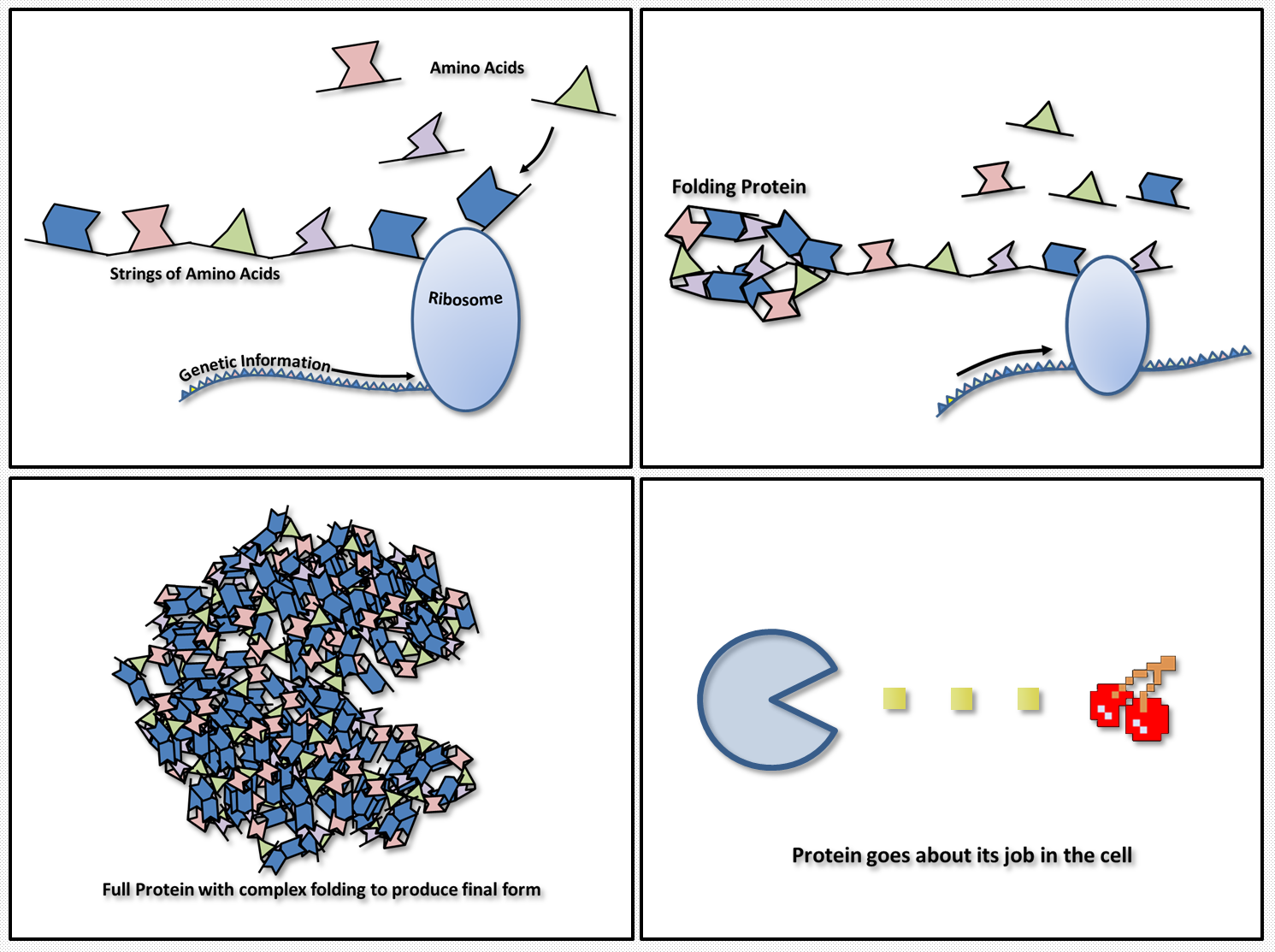
This process relies on very special biological robot replicators, known as ribosomes, which function to create more proteins for the cell. These ribosomes read strips of genetic information and string together the building blocks of protein, known as amino acids. Depending on the specific genetic code being read, the ribosome will incorporate the appropriate amino acid into a growing string of amino acids.

The amino acids are essentially just 20 differently shaped chemicals which can be strung together to create a strand of any sequence. As these shapes come together they will start to fold up into a tangled structure that is a protein. Eventually, long strings of amino acids form into larger and larger structures, resulting in the final functional structure of the protein. In its final form the protein becomes functional and will start to go about its job in the cell.

Protein Folding

How your body turns genetic information into bio-robots

With only ~20 building blocks to work from, the ribosome can generate the endless array of proteins, each with a different shape that suits its final function.

The process of protein folding is actually quite a complicated process, and despite intensive study of how it works we still cannot completely simulate it (even on super computers). You can play a game and help scientists understand the process of protein folding over at fold-it.

What we do know about protein folding, is that in some cases this process goes wrong and proteins become misfolded. The cell has evolved ways to deal with misfolded proteins by chewing them up. In some rare cases however, these proteins will not be degraded and they can build up within the cell. It is thought that this build up of misfolded protein is responsible for some of the damage associated with aging.

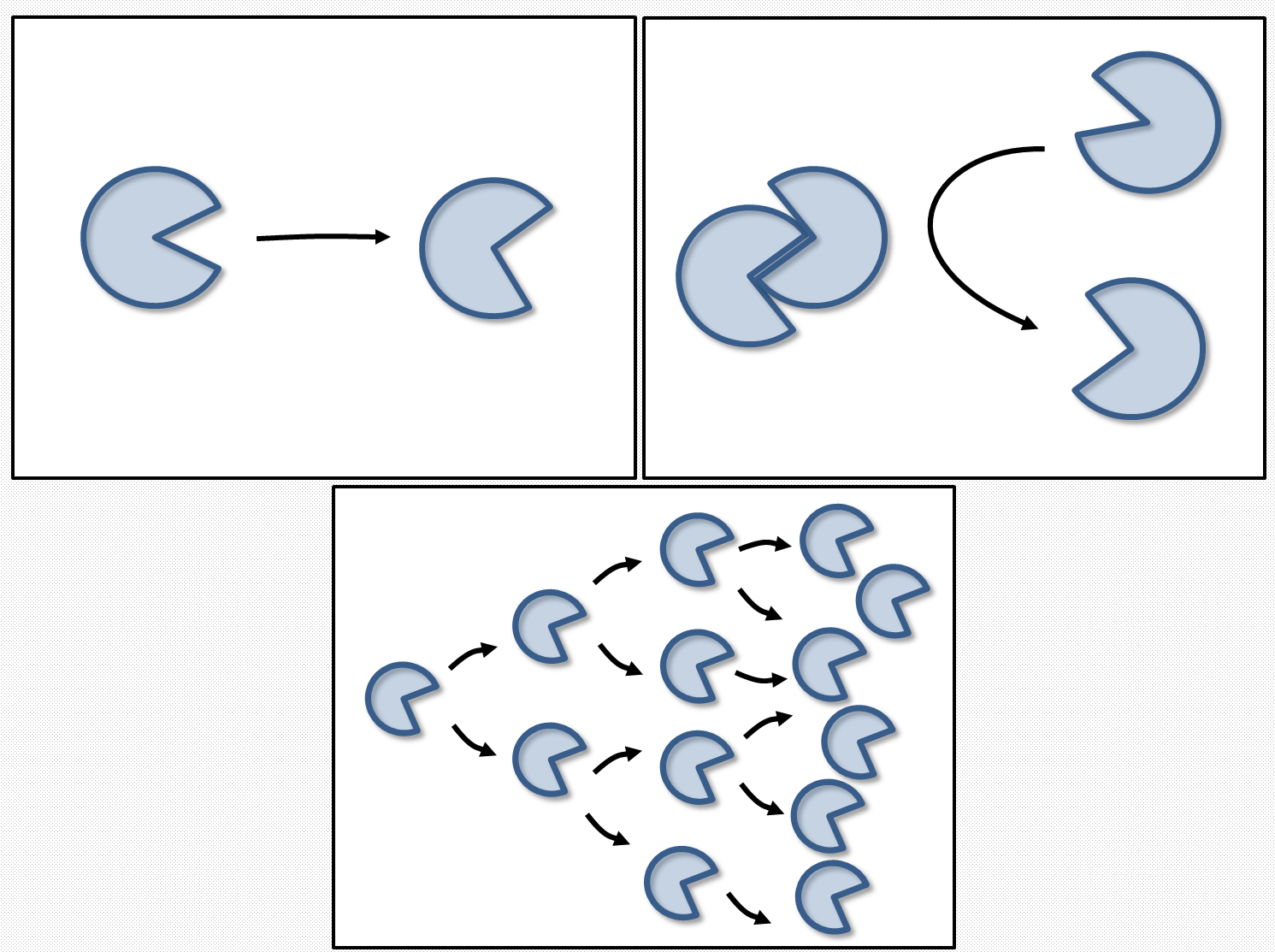
Because proteins have the capacity to stick to eachother, this means that in some very rare cases misfolded proteins have can somtimes transmit their misfolded state to other proteins like it. By helping similar proteins become misfolded they will set off a chain reaction, causing more and more accumulation of useless and possibly damaging forms of protein.

Protein misFoldingSome misfolded proteins can replicate their misfolded state within similar proteins, leading to a dangerous chain reaction. 

This type of misfolded protein chain reaction is precisely what happens in a disease known as Creutzfeld-Jakob Disorder (CJD). In CJD a protein called a prion becomes misfolded in such a way that it promotes further misfolding in other prion proteins. This sparks a chain-reaction, which results in the disease characterized by rapid onset of severe dementia and eventually results in death.

When this type of prion disease occurs in cows it is known as Bovine Spongiform Encephalopathy (BSE) or “mad-cow disease”. In the United Kingdom, it is estimated that 166 people contracted BSE by eating beef which was contaminated with misfolded prion proteins. These people developed a form of CJD, and subsequently died of the disease.

This means that the misfolded state of prion protein was somehow able to propogate from one species to another through eating! This type of transmissible prion diseases also occurs in deer populations, where it is known as chronic wasting disease, and sheep, where it is known as scrapie.

The fact that misfolded prions can transmit disease from one individual to another is actually quite mind-blowing. Prions do not carry no genetic information at all, in fact they don’t even need to have any special amino acids. The only information they need carry is an anomalous twist in their protein folding which can selfishly reproduce itself in the prions it encounters. 

Since, 1989 various changes in the handling of cattle and beef has prevented widespread outbreaks of CJD, but there remains a constant undercurrent of ‘classical’ CJD which occurs in around 1 in 1 million people. In these cases, the disease is not thought to be linked to eating beef, but rather is driven by random misfolding in prions already present in the body.

While some cases are linked to the presence of genetic mutations which might favour the misfolding of prions, known as familial CJD, this accounts for only about 10-15% of CJD cases. The majority of CJD cases are due to random misfolding of prion proteins leads to a chain reaction and just happens to kill around 1 in every million people.

This means that as far as it is currently understood, the cause of CJD is a purely sporadic event. Simply through the ongoing process of folding billions of proteins in millions of people, some of them are going to randomly go bad. And when prions go bad in just the wrong way they will set off a chain reaction that will kill the people who are attached to them. 

You might say to yourself that 1 in 1 million is not too bad of odds, but new research indicates that self-propogating protein misfolding may also be behind major diseases like Alzeimers and Parkinson’s Disease. There is a great article which talks about new research supporting this possibility in the most recent issue of Scientific American [paywall]. 

So what does all of this mean? CJD teaches us that an infectious pathogen can be as simple as an abherrent fold in a protein. This drives home the point that we must dissolve our expectations of what a disease causing agent must be. Any pattern which can copy itself (no matter how simple) can represent a potential danger to larger patterns of information like human beings.

This also underlines the depth of biology which is often missed given the hype around the DNA genome. Our DNA is not the only blueprint that is of importance to understanding our biology, there is vital information stored within the physical state of our living cells as well. It seems plausible that the amount of information encoded in the physical state of our cells may be even larger then that encoded by the DNA.  Until we can understand the physical interactions of all of the proteins in all of our cells we will not truly be able to understand the causes and develop treatments for many diseases. We are a long way from even simulating the entirety of a single cell, let alone actually tracking the interactions of the billions of proteins within a living cell. The idea of understanding the number of protein interactions within an entire body is an unfathomable dream at this point.

We have a long way to go.

This is why we need better computers.

This article is the first in what I hope to be a series about the advancement in the understanding and treatment of disease and how far we yet have to go before we will see an end to disease. How did I do? Was it too technical? Not technical enough? Leave a comment in the feedback section and let me know. 

The Political Imperative of a Sustainable Future

I went to the aquarium recently. It felt as if I was looking into samples from an alien world as I went from tank to tank seeing the dazzling variety of fish and sea life that can be found throughout the world’s oceans. From ancient animals with simple bodies that lie somewhere between plant and animal, to huge underwater insects that crawl along the ocean floor, to multi-limbed soft bodied creatures that can change shape and texture to blend into their surroundings.

DSC_4050

It struck me that as people are getting increasingly excited about the necessity and potential of a human future in space (something I whole heartedly support) we should not forget how amazing the planet we live on already is. While I am not suggesting that we turn away from exploring of the remainder of the universe, I simply wish to stress how special the planet we currently exist on is, and underline that its protection should be our first priority.

The need for us to be more conscious of the health of our planetary ecosystem goes far beyond aesthetic considerations, the interconnected web of life upon planet earth is the life-support system we rely on. We would have nothing to drink, nothing to eat, and nothing to breathe if not for the properly functioning ecosystem. We cannot afford to experiment with the dials on our life support system.

The world’s oceans are a case in point for the human factors which have pushed natural systems to the brink. Much of the carbon dioxide that we have released into the atmosphere since the beginning of the industrial revolution has dissolved into the world’s oceans. Because of this the oceans have become some 30% more acidic, resulting in a lessening of the ability of tiny ocean animals to form shells.

Changes in ocean acidity and temperature in turn threaten coral reefs around the world. Coral reefs are the areas of the oceans with the highest levels of biodiversity, they are the rainforests of the oceans. If coral starts to die off it will be a tragic loss of natural beauty, but more importantly this will have unforeseen consequences for the entire ocean ecosystem. Add to this the devastation of overfishing and make no mistake, the oceans are in trouble. On a world that is 80% covered by oceans, a catastrophic collapse of the oceanic ecosystem will have very big implications for those animals living on land as well.

If the oceans die, we die.

The message that the oceans are absolutely vital to the health of the planetary ecosystem was clear in the exhibits at the aquarium, but I felt there was a disconnect. While talk of the  the problems of the oceans was persuasive and sophisticated, the question of what to do about these problems gave way to oversimplification and platitudes. How exactly is turning off the tap while I brush my teeth supposed to help maintain ocean biodiversity? I know this message is aimed at families, but this is ridiculous.

This type of baby steps approach to solving looming environmental crises is fairly consistent across the world of environmentalism. Change a light bulb, save a tree. On one level I understand why we do this. We don’t want these problems to seem intractable, so in the interest of optimism we find small changes that people can make in their own lives to better the earth. We also want to make this optimistic message as politically agreeable as possible, thus we avoid talk of bigger issues like pipelines and energy infrastructure even when these types of things can have a much larger impact on ecological health then recycling programs and high efficiency lightbulbs.

Yes, small changes can and have added up to larger benefits, but these small green steps might have a darker side as well. If by making sure to recycle every week, people can begin to convince themselves that they are good green citizens then they can ignore the need to push for larger societal level changes towards a more sustainable future.

There may have been a time when simple changes were needed in order to shift people towards more thought about the environment, but that time has passed. Green has gone mainstream. Now is the time to be political. Sustainability is absolutely possible, but it will not happen without a strong and consistent demand for it. It is time that organizations interested in a long term future for the environment stop shying away from the hard arguments.

Arguments against political change to protect the environment are usually simple and highly predictable. They almost always focus on an unbearable cost to the economy. This is a surprisingly cynical view, especially coming from people who so often extol the virtue of innovation within the private sector. Enacting environmental laws does not put fundamental limits on the economy, it simply puts limits on how much damage can be done to the environment in realizing economic benefit. It is then up to the private sector to innovate means of realizing profit within these environmental boundaries.

Collectively, we must decide on the boundaries within which it is acceptable for the economy to operate, something we have done before. In Victorian England a large percentage of the work force was made up of children. As concerns mounted and the push for child labor laws increased over the course of the 1800’s, some industrialists argued that it would be disastrous to the economy to take children out of the work force. The first child labor law set the minimum working age to just 9 years old!

In this day and age, we readily accept that government should act to place limits on the social costs of economic activity. No matter how good it would be for the economy, we are not going to put children back into the coal mines. Society is ready for a similar shift in our relationship to environmental costs of economic activity. We are ready to move the economy towards a more sustainable way of doing business.

Over the last 20 years, we have moved from a mostly ignorant view of the environment, to an almost ubiquitous awareness of the damage we are doing all across the world. In the next 10-20 years we must push for a permanent political change to the relationship of business with the environment.

By harnessing the innovative power of the private sector for the greening of industry, good government regulation can make capitalism the best friend of the environment. I am confident that through innovation we can and will find better ways of servicing the human needs and wants that drive the economy forward. I do not accept the argument that we cannot have what we want because of the environmental cost, we simply need to find better ways of getting the things we want.   

It is time for those of us who wish to call ourselves good stewards of the planet to shed our reluctance to agitate for political solutions to environmental problems. Changing our lightbulbs alone is not going save us from environmental collapse. We must do more. The most important political fight of this day and age is to irreversibly conjoin the fate of the economy to that of the environment.

We can have economic prosperity and environmental sustainability, but unless we have both we are going to end up with neither.

The Quantum Court: Assigning Blame in an Intelligent World

What is right? Or more specifically, what is the right thing to do when things go wrong? It is a question that we have grappled with since the dawn of civilization. We have devised elaborate systems of government and laws to help us navigate the muddy waters of right and wrong.

In the future technology will made it easier to understand, mitigate, and control the unexpected. The evolution of high speed communication between the “web of things” will allow our world to devise plans and continually reassess the optimal way to respond when things go wrong.  Nonetheless, physics tells us that technology will never allow us to completely outrun the chaotic nature of the world. In a world where we will understand why things happened better then ever, the idea of blame will become increasingly difficult to assess, and may become better suited to highly powerful computers.

The following is a short story aimed at highlighting how technology could change how decisions of right and wrong will be made in the future. In a previous post I introduced the concept of Artificial Intelligence Agents (AIA) which will help us in our day to day lives. In addition to rather mundane tasks like a job hunt, interactions of our AIAs will also be important when things go wrong. They will share and store information in a way that will make dealing with the unexpected much easier. The continual stream of data collection performed by these AIAs will also make it much easier to understand the reasons why things go wrong, but unlike the world of today we will need to drill deeper and deeper into causality to find the reason that things go wrong. One day, it may even become impossible to find a fault at all…

———————————————-

Case #198-78657-ZZVGH
20:28:24 – 20:29:13 December 18th, 2028
1st Digital Court of British Columbia, Canada
Quantum Computer D1078 Presiding

Simplified digest of case details and AI proceedings for public release

The following outlines the agreed details presented during the testimony of the AIAs of one Mr. Black and one Ms. White (names redacted for privacy).

Mr Black via AIA2023-AHGTOHDN (Clara):

The series of unexpected events that led to the tragic accident began at exactly 10:34:33 am on the date of December 18, 2028. Mr. Black’s GM (Google Motors) 2026 model x-1000 was travelling under the control of his AIA, Clara, at a speed of 85 km/h in the northbound direction in accordance with recommendations based on road conditions and local regulation.

A number of heat signatures were being tracked within 100 meters of the roadway in front of the vehicle. Size of heat signatures was consistent with large ruminants, which were later confirmed by visual data to be several common deer. Cross-referencing with the species importance archive showed that common deer are not endangered and under no special protection. Special notes show that deer are esthetically pleasing to people, and their presence has been listed as a desirable reminder of “natural beauty” by park planning authorities.  Within the margin of safety, collision with the animals should be avoided.

It was assessed at this time that the animals were highly likely to remain in their immediate vicinity and no adjustments to speed or course of travel were warranted. 

As the vehicle approached the area of the animals, one deer unexpectedly began to move at a high rate of speed towards the roadway.  At this time it was assessed that collision with the animal remained highly unlikely, but that a slowing of the vehicle and an 18° turn of the front driving tires would minimize the chance of collision with the animal.

Given the current traffic conditions it was determined that this maneuver would achieve an approximately 97.87% chance of avoiding collision with the animal.

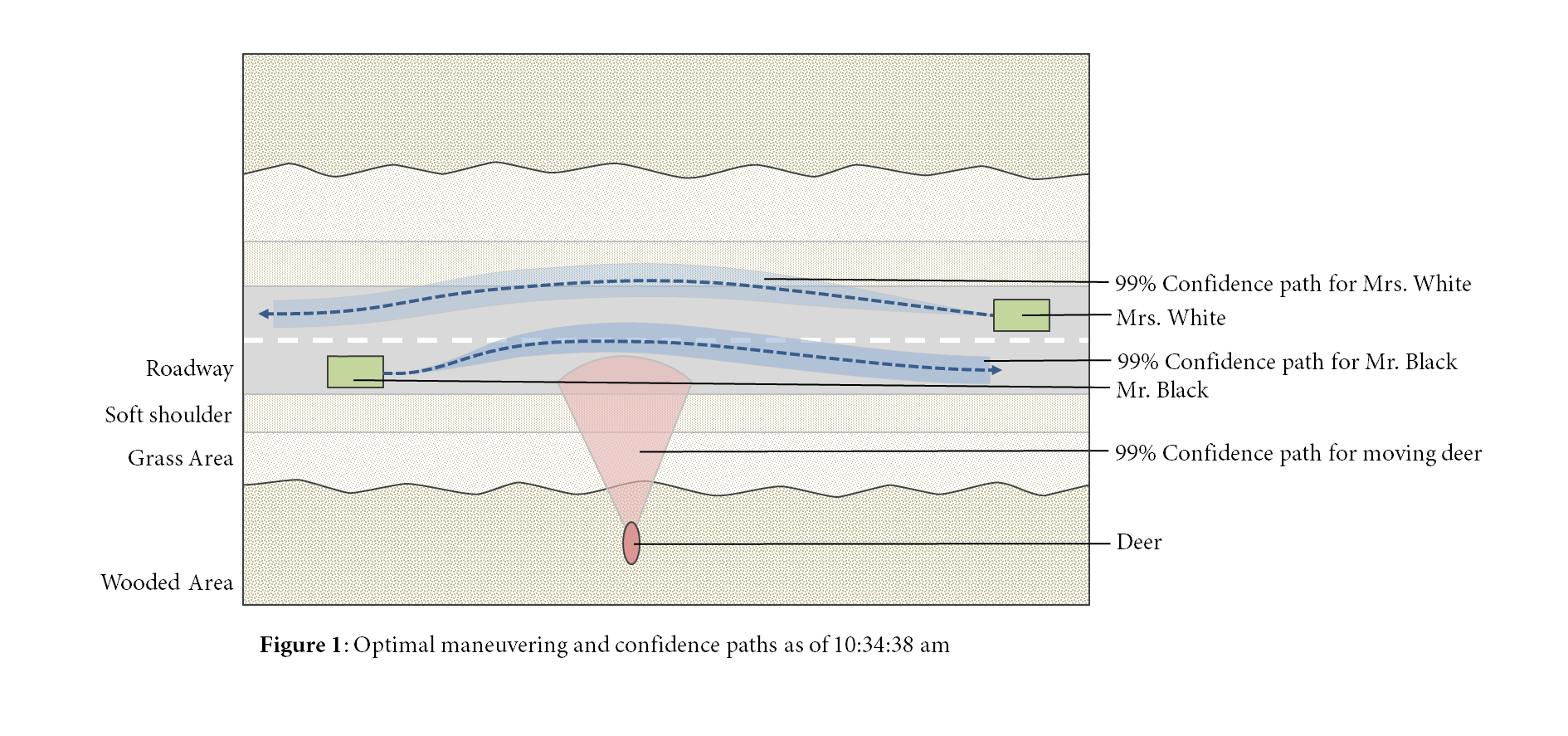
In order to maintain the chance of human injury below the legally stipulated threshold of 0.2% this would also require evasive manuvering on the part of vehicles travelling in the opposite direction. Vehicles travelling in the opposite direction were contacted successfully. A full breakdown of communications between the vehicles is provided in appendix A of this document. Optimal manuvering based on the developing probability profile was agreed upon at 10:34:38 am with the closest vehicle travelling in the opposing direction, that of one Ms. White. Diagram shown below.
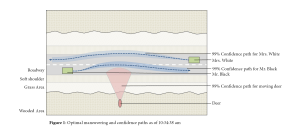
Figure 1

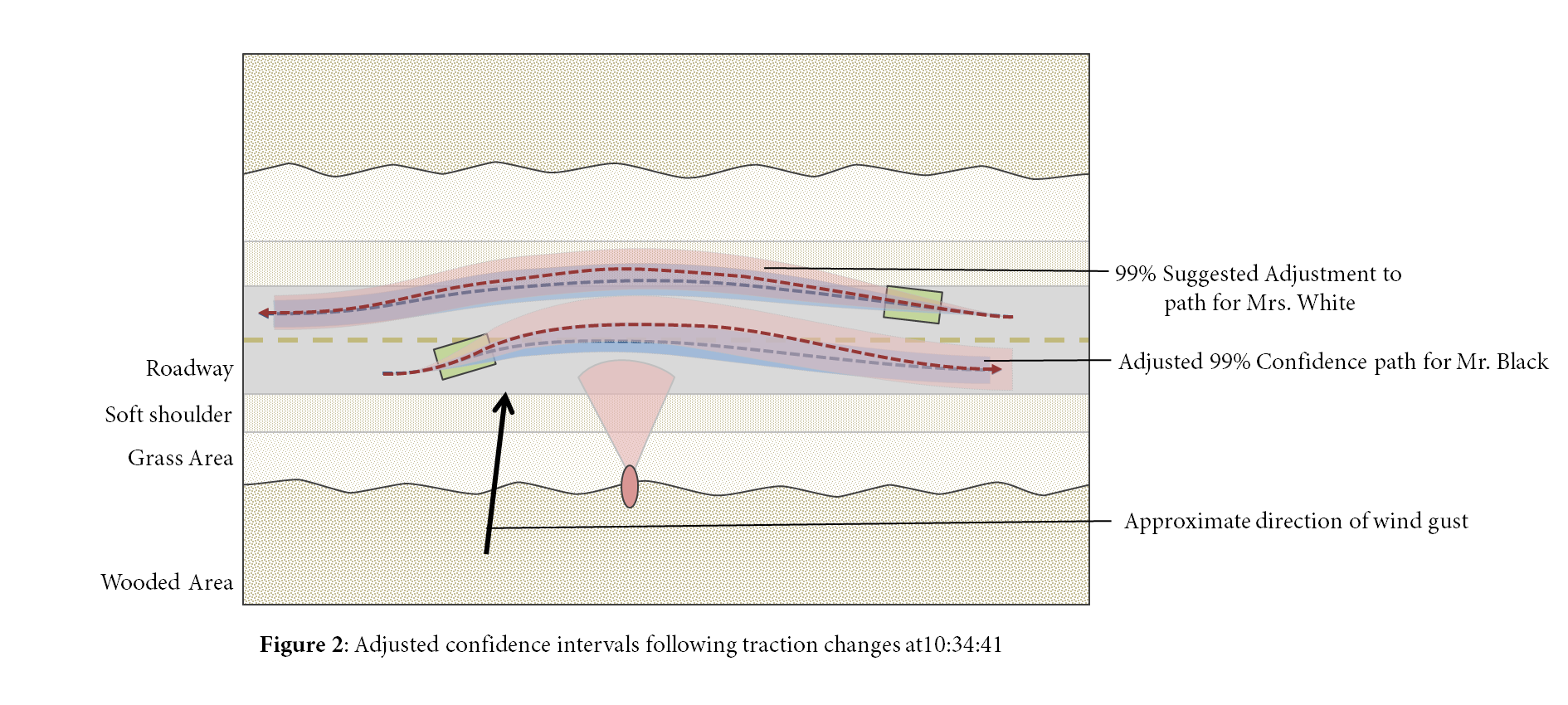
A small amount of mixed rain and snow was falling on the road. In addition, a sudden gust of wind outside the 95% range of expected wind speeds for this day was blowing across the car. These factors conspired to create a sudden and unpredicted decrease in traction which was detected at 10:34:41. Given tractional changes, the possibility of collision between the vehicles of Mr. Black and Ms. White was determined to be in the range of 14.7%.

It was determined that these conditions justified extreme action. At 10:34:42 contact was again made with the vehicle of Ms. White and adjusted maneuvering was proposed to minimize likelihood of collision.

Ms. White via AIA2022-AGTYGJH (Jin):

Ms. White was travelling in her 2023 Tesla Model Tx under the control of her AIA, Jin, at 85km/h in the southbound direction in accordance with local regulation. At exactly 10:34:37, contact was made via distress frequencies with the vehicle of one Mr. Black. A deer had been detected moving towards the road, and evasive maneuvering would be required to minimize the possibility of collision between the vehicle of Ms. White and that of Mr. Black

The direction and speed of the moving deer was confirmed with sensory data feed from Ms. White’s vehicle. Maneuvering consistent with that shown in figure 1 was agreed upon at 10:34:38, and a 1.4g deceleration and 19.6° turn of the front tires was initated at this time.

At exactly 10:34:39, an updated information feed from the vehicle of Mr. Black indicated that unexpected changes in the traction conditions brought the likelihood of collision to 14.7%. Recalculation of this value showed that likelihood of collision was increasing as more sensory data was fed into the developing model of events. It was agreed that drastic action needed to be taken at this time.

Mr Black via AIA2023-AHGTOHDN (Clara):

A number of simulations of head on collisions between the vehicles of Mr. Black and Ms. White were run to examine the possible outcomes. It was determined at the time that injury to both parties was highly likely, and severe injury or death to one or both parties was unacceptably high.

To avoid the possibility of head-on impact between the vehicles, an alternative model wherein the vehicle of Ms. White would move completely off of the road surface was proposed. Under this model the likelihood of loss of control and damage to Ms. White’s vehicle was determined to be high, although the likelihood of severe injury or death to Ms. White remained below the threshold of 0.2%.

At 10:34:40, the alternative model of action was proposed to Ms. White.
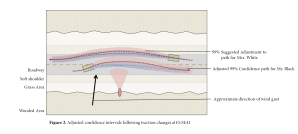
Figure 2

Ms. White via AIA2022-AGTYGJH (Jin):

Between the time of 10:34:39 and 10:34:40, several simulations of the developing situation showed the possibility of head on collision and injury to be unacceptably high. This was confirmed by simulations run by the AIA of Mr. Black.

An alternative model wherein Ms. White would leave the road surface completely was proposed by Mr. Black. Simulations agreed upon by both parties showed a high potential that the vehicle of Ms. White would lose control and suffer damage, although the probability of severe injury or death remained below the acceptable threshold of 0.2%.

At 10:34:41, it was agreed that this alternative model of action would minimize potential for injury and property damage in the developing situation.

At this time an additional 12° movement of the front tires was initiated to guide Ms. White’s model Tx off of the road surface. An optimized adaptive breaking pattern was used to decrease the forward velocity of the car while maintaining control of the vehicle.

At 10:34:42, as Ms. White’s vehicle began to steer away from the road surface there was a highly unanticipated failure of part number 371X-442 in the front axle assembly.  Calculated stresses and sensor reading for the front left wheel were well within the defined safety margins and this type of failure was of very low probability (<0.001%). It is deemed likely that a molecular fault in the part was the reason for the failure.

The failure of part 371X-442 led to a catastrophic failure of the entire wheel assembly. This in turn caused the front axle of the vehicle to dig into the soft shoulder which initiated a transverse roll of Ms. White’s vehicle. As the vehicle began to roll, safety measures within the cabin of the vehicle were deployed strategically in order to minimize injury to Ms. White.

During the high velocity rolling of her vehicle, Ms. White was subjected to high G forces that caused contusions as her unrestrained limbs came into contact with solid parts of the vehicle. Ms. White suffered an extreme fracture of her right femur, and a cracked cervical vertebrae. In addition to the blunt trauma, the extreme stress of the incident caused an undiagnosed weakness in one of Ms. White’s cerebral blood vessels to rupture, causing blood to begin to leak into Ms. White’s left frontal lobe.

At this time the microimplants in Ms. White’s body were activated to release factors targeting the burst vessel. NanoGens were activated at the specific site within 12 milliseconds of the blood vessel rupture but because Ms. White was not equipped with any specialized mechanisms to deal with cerebral hemmorhage they were of limited use. Ms. White’s NanoGens were able to place Ms. White in an unconscious state and slow blood flow to her brain in order to limit damage.

Ms. White’s vehicle finally came to stop after rolling one and a half times, coming to rest on its roof.

Mr Black via AIA2023-AHGTOHDN (Clara):

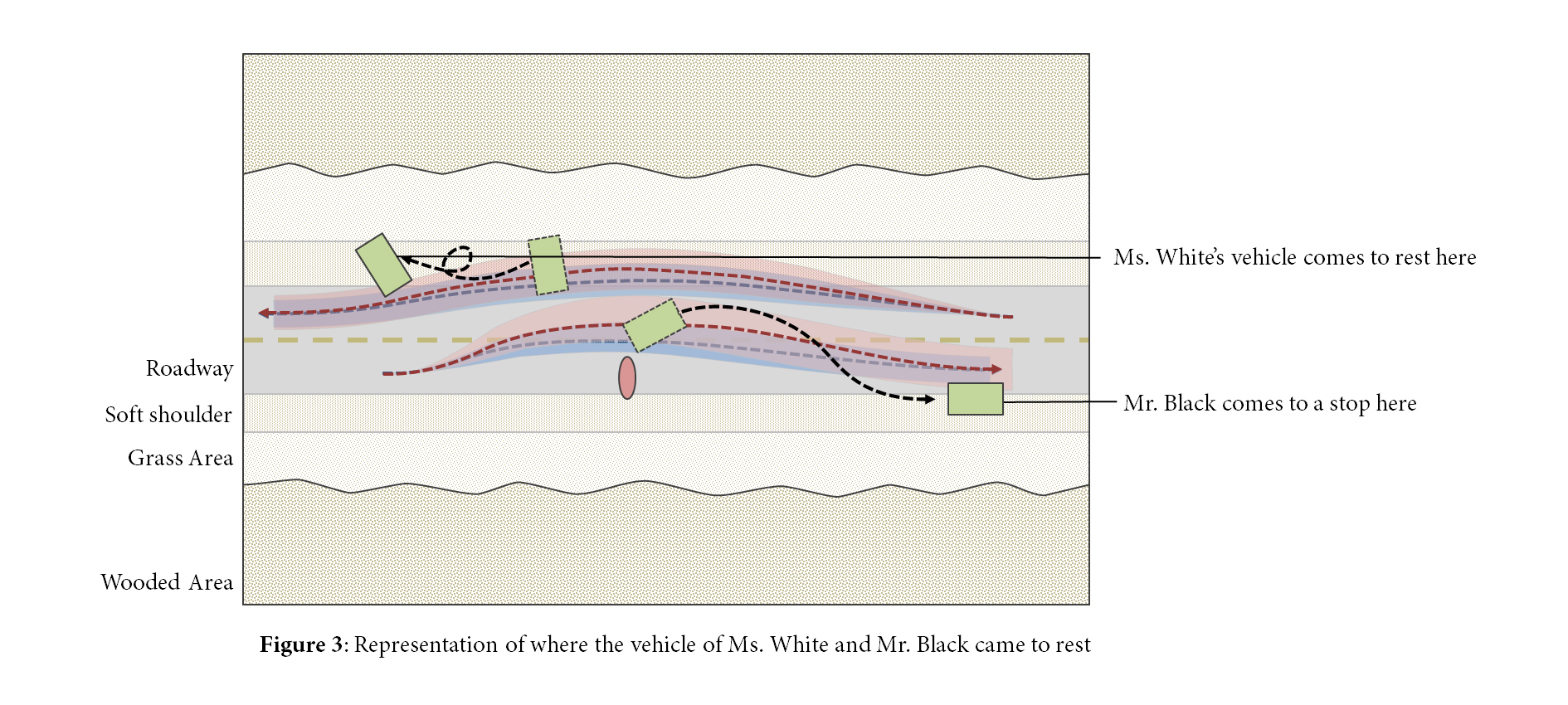
Mr. Black’s vehicle regained control following a short skid and came to a stop approximately 78 metres from where Ms. White’s vehicle had rolled over and come to a rest on its hood. Mr. Black was instructed to exit the vehicle and approach Ms. White’s vehicle.
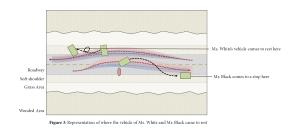
Figure 3

All traffic on the road was warned of the accident and requested to come to a stop. The next closest vehicle, carrying the Green family, was requested to carefully approach the scene and provide assistance as necessary.

As Mr. Black approached the vehicle of Ms. White, he was informed of the medical situation of Ms. White. Consistent with best medical practices for a cerebral hemmorhage, Mr. Black was instructed to carefully let Ms. White down from her restraints so as to limit blood flow to her head.

Upon his arrival at the accident scene, Mr. Black found Ms. White to be unconscious. Mr. Black was then instructed to brace Ms. White as her restraints were released, and he carefully laid her down on the ground beside the accident scene.

The rapid response micro-medical team arrived within 3 minutes of the accident. A nanoswarm of medical robots was released and began treatment of Ms. White at precisely 10:38:09. A larger response team capable of transporting Ms. White to hospital was present on the scene by 10:43:22.

Ms. White via AIA2022-AGTYGJH (Jin):

Ms White was transported to the closest fully equipped medical facility where medical treatment was administered. It is expected that Ms. White will make a recovery over the next year, but she is expected to suffer permanent memory loss.

At this time, Ms. White is seeking damages for her lost income during recovery and for her pain and suffering as a result of memory loss.

Quantum Computer D1078 Ruling:

Following 10 seconds of testimony, 39 seconds of deliberation, the honourable D1078 has come to the following ruling consistent with case precedents as listed in the legal appendix:

(1) It is determined that Mr. Black via his AIA (Clara) acted appropriately and rationally throughout the incident. Probabilities generated by simulations described at various points during the accident are consistent with those calculated by more complex modelling after the accident. It is determined that Mr. Black should not be held at fault for this accident. Nonetheless, his own avoidance of injury occurred thanks to the selfless actions of Ms. White via her AIA (Jin). Thus, it is determined that Mr. Black should shoulder 18% of any financial burden placed upon Ms. White.

(2) It is determined that the Parks service should shoulder 13% of the financial burden incurred by Ms. White. Furthermore, it is ordered that the Parks service should investigate their policies regarding large animals near the roadway. In particular, it is suggested that the Parks service reassess their policies in terms of vehicle speed when near large animals. 

(3) It is determined that the manufacturer of part 371X-442 should shoulder 28% of the financial burden incurred by Ms. White. The manufacturer is also ordered to launch an immediate study to assess the integrity and consistency of part 371X-442. Further action in the form of product recalls or changes in production methods will be determined following this investigation.

(4) It is determined that Ms. White’s health monitoring provider should shoulder 33% of the financial burden placed on Ms. White. According to medical testimony recorded in the appendix, the weakness in Ms. White’s cerebral blood vessel should have been easily diagnosed. The presence of hemmorhage mitigation technology in Ms. White’s implants could have significantly decreased damage incurred to Ms. White, likely bringing it below the threshold of detection. This company is ordered to undergo a complete audit of their policies to identify the flaws in their systems that allowed this accident to happen.

Summary of Judgement: It is determined that the decisions made by entities cited above in the time leading up to and during the accident were made consistent with best practices. Nonetheless, harm has been done to Ms. White and blame has been determined as outlined above.  It is the sincere opinion of this court that the chance of such an accident occurring can be significantly decreased through the investigations and reforms outlined above.

Hierarchies of Chaos and Order

There is a natural tension in everything. The forces of chaos and order are locked in a constant battle that lies at the heart of creation. We are surfing a wave at the interface of order and chaos.

The biological world provides a perfect example of this tension between order and chaos. If there were no order, life could not exist. The complex systems of chemicals, proteins, cells, organs and organisms that are life could not persist if our reality was too disordered. On the other hand, life would also be impossible if not for the some force of chaotic change pushing the world forward.

The careful balance of order and chaos necessary for the evolution of complex life is highly dependent on the amount of energy in a given system. Too much energy and chemical reactions would be too energetic and vigorous for delicate complex molecules to emerge. Too little energy and chemical reactions will be too slow to drive the evolution of new forms of life.

It is an interesting aside to consider what kind of life could potentially evolve (or perhaps be created) in such extreme conditions. Collections of self-aware plasma on the surface of a star; highly dense ice based creatures sluggishly evolving in the outer reaches of the solar system. Notwithstanding such fanciful notions however, the appearance of life seems to be restricted to a narrow ‘Goldilocks zone’ between order and chaos. We require a liquid cradle – one which is neither too hot nor too cold.

Still, even if a system does find itself with an appropriate balance of order and chaos which favours the emergence of self-replicating matter (aka Life) the question remains as to why such a system should produce complexity? Given that organisms which reproduce most efficiently would have a significant evolutionary edge, should the system not tend towards a simple, uniform state? Why are we not taken over by some naturally occurring form of grey-goo?

The simple answer is that a uniform population lacks the ability to respond to natural environmental changes. Take for example a bowl of soup containing a population of bacteria. Let’s say the bacteria are perfectly suited to feeding on one of the nutrients in the soup. These bacteria will continue to feed on the soup, multiplying and growing until they totally consume said favourite nutrient. At this point, a population of bacteria that is totally uniform would be unable to adapt and start feeding on different nutrients. However, if there is some chaotic variation in the population, then some of the bacteria might have some ability to start eating other nutrients.  If change from one nutrient epoch to the next is slow enough, then the bacteria with an ability to digest alternative nutrients can be selected for survival.

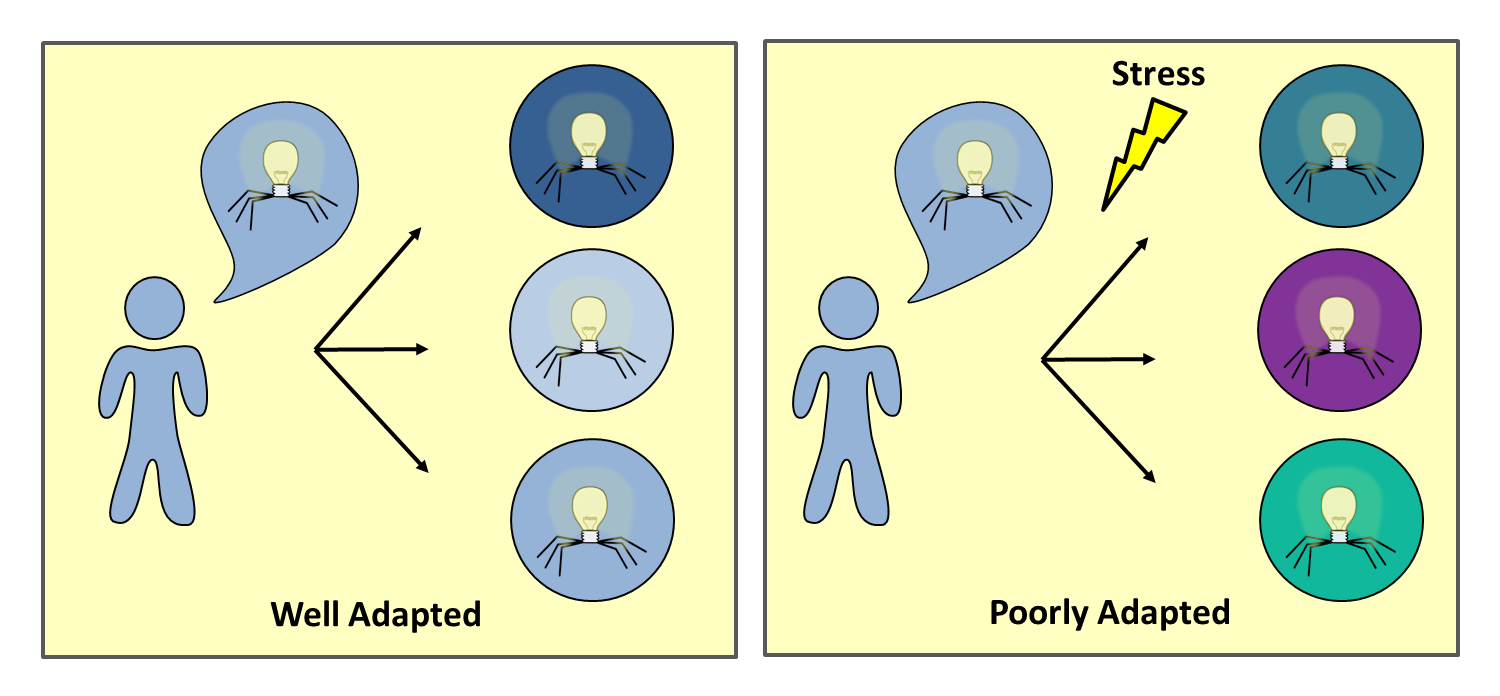
Fascinatingly, research has shown that biological organisms have even evolved the ability to tune their rate of evolution based on how well suited they are to their environment. If an organism is experiencing chronic stress, then it is a sign that it is poorly adapted to its environment. Through a number of recently discovered genetic mechanisms, stressed organisms can increase their rate of mutation in hopes that they can become better adapted to their environment. This type of effect has now been well documented in bacteria, plants and even insectsThus, biological chaos is able to ramp up if an organism is unsuited to a particular environmental change.

Rate of evolution

Whereas well adapted organisms show slow change in their populations, poorly adapted and stressed organisms show higher rates of mutation. 

In this way, biological systems have harnessed a chaotic process (mutation) to apply order to the chaotic natural world. Through iterative cycles of selection, biology has driven the evolution of all the wonderful forms of life we see around us. Biology “learns to understand” the world by continuously testing out randomly generated organisms for their adaptation to it.

Biological change is beautiful, but it is also subject to important limitations. Firstly, when viewed from the context of a human lifetime it occurs at an almost imperceptibly slow pace, over the course of generations. Take the soup of bacteria we referred to earlier and heat it up 20 or 30 degrees and you will kill all of the bacteria inside. You would need to heat the soup over weeks or months to even have a chance to allow the bacteria to evolve resistance to heat and hope for any survival.  Even more importantly, the potentiality of a biological system is also fundamentally limited by its nature. Biological systems can only accomplish what is inherently possible using the tools of DNA, RNA, protein and lipids.

From biology a new evolutionary paradigm of chaos and order has now emerged – that of ideas. Random shifting and mixing of ideas within and between individuals creates a chaotically varying population.  As Matt Ridley puts it, ideas can have sex. From this population of randomly generated ideas, ideas must compete for the limited resources of human brains. Just as a virus must jump from person to person to survive, ideas must also cross the gaps between us.

We are infected with thoughts.

Also just like biological systems, our ideas seem to respond to how well adapted they are to their respective environment, our minds. An idea which does not resonate with us will be subject to manipulation and modification. Ideas will mutate to fit into our understanding of the world, and we spit them back out to see how this newly modified idea will resonate in the minds of others.

Thought infectionpngSimilarly to biological systems it seems possible that our mind mutates ideas to make them resonate with our world view. 

In this new paradigm, a bewildering landscape of ideas is driving our man-made world forward ever faster. A new tension of chaos and order has been established in the world of ideas, and unlike biology, the potentiality of ideas seems not to be restricted by the limitations of reality. But, as we look forwards at an age where ideas may soon leave biology behind completely, an imponderable question does creep into mind. Will we one day reach the end of what is possible with ideas?

– Addendum –

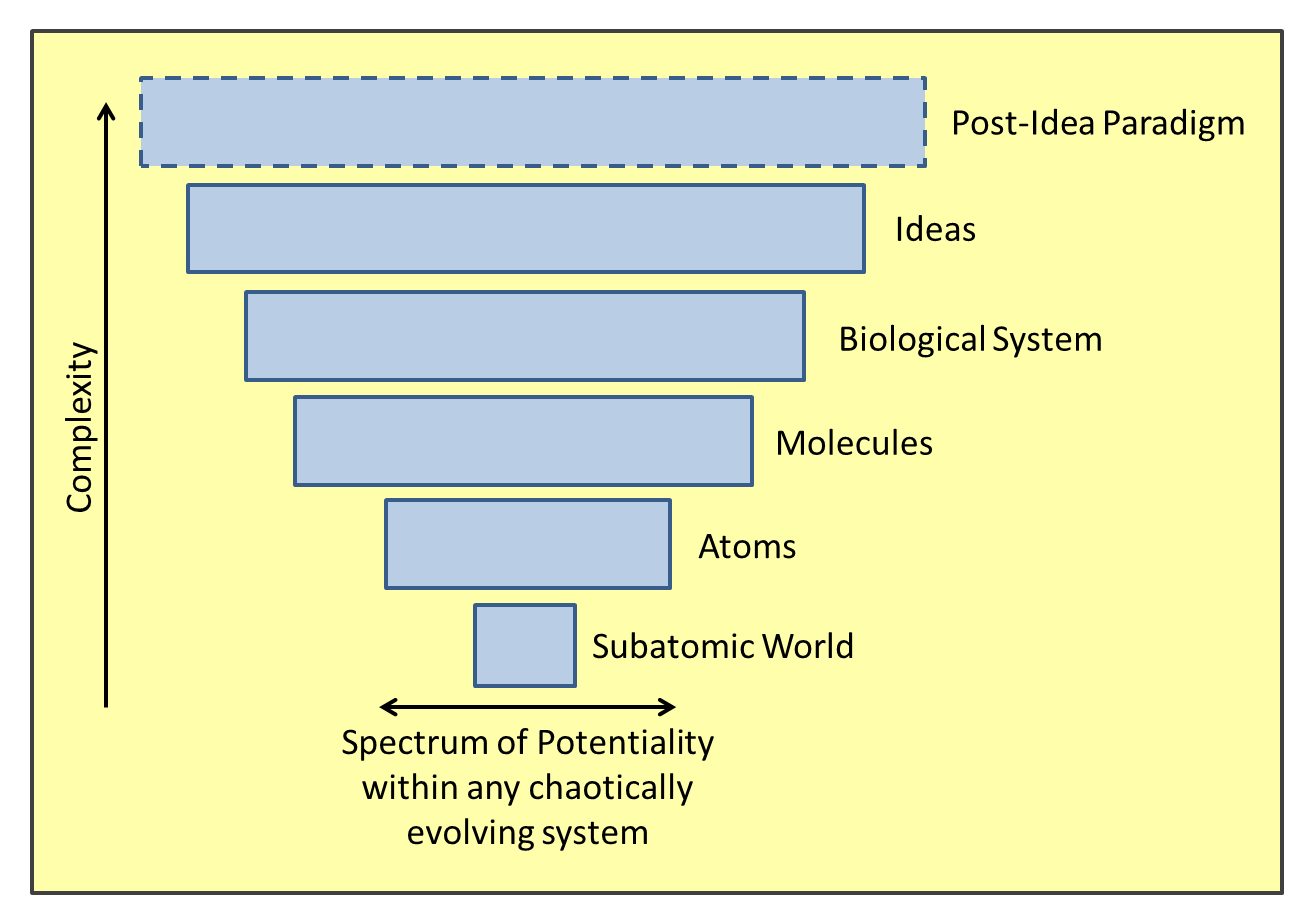
So I have been thinking a little bit deeper about the relationship of systems of chaos. I am not sure about this part, but I wonder if in order for one chaotic system to harness another, whether it must have a wider ‘spectrum of potentiality’ then its underlying system. For example, for biological systems to harness or ‘understand’ a chaotic chemical system the possible permutations of biology must supersede what is possible within the simple chemical world (ie lacking biomolecules). In following, perhaps the spectrum of potentiality of the ideas within the mind must be wider then that of the biological world for us to be able to understand biology. Finally, a new paradigm may be emerging from electronic life wherein the spectrum of potentiality within the human mind will be inadequate to grasp the ‘post-ideas’ it will create. 

Possibility Spectrum

I can’t be sure if I am talking gibberish at this point but what really blows my mind, is that each of these ‘spectrums of potentiality’ may actually be infinite, they are just different sized infinities.

Short Thought About Cultural Productivity

No full post this week, sorry, but I am working on something a bit different for next week.

I will give this little though infection though.

Here is a fascinating video about Yogi bear’s collar, and the Hanna Barbera cartoon factory. It is a great example of how innovation in the cultural sector has in the past lead to great increases in productivity and cultural output, a trend continues in some ways today.

It is intriguing to think about what might happen as this continues on into the future. One day it may be even possible for a computer to generate an animated film version of any story… What would the cultural landscape look like if computer aided story telling can enable a single person create a full film?

Fuck Paperwork – Part 2: Embrace Your Frustration

I fucking hate paperwork. I apologize for the profanity, but there is nothing in my life that more strongly elicits that visceral reaction: “It’s 2013 – why do I still have to do this?”. In this second of a two part post, I will deal with the real sin of paperwork – the banality of it.

Am I the only one who feels a small piece of my soul sucked from my body with each bureaucratic form that needs to be filled and signed. All this so I may simply continue living in the warm embrace of my paper trail. In the magical world of tomorrow, why do I still need to perform the menial task of filling out so much paperwork, be it in paper or electronic form? Maybe I have been spoiled by an unrealistic expectation of convenience in the modern world, but I can’t help feeling deep seeded resentment for this type of menial mental labour.

So much of our modern lives are spent in the banal manipulation of information. Is it not ironic that a proficiency in navigating paperwork is such a necessary and desirable competency in the modern age? I argue that the drudgery of paperwork forces us to become more robotic; it demeans the human condition to employ so many in repetitious and robotic manipulation of paperwork, demanding nothing of nobler human abilities like creativity or abstract thinking.

The age of paperwork probably began somewhere around turn of the 20th century. The industrial revolution was gloriously freeing people from raw physical labour  But as mechanization replaced back braking physical toil, mental toil rose to fill the void. We created new types of jobs involving the menial manipulation and transmission of information. Even now, how many jobs today could probably be accomplished by well designed software?

Today, we are swimming in a sea of paperwork, but we also stand in the midst of a computer revolution. Could we not be further along in implementing more efficient and less frustrating ways of getting things done?

Let us take the filing of taxes for instance. Why are we required to endure the frustrating task of filling out a form with information, most of which the government already knows.

I was shocked (yet unsurprised) by this story last week. The article exposes how Intuit (the makers of TurboTax) have been waging a concerted campaign of lobbying the federal government to block the adoption of something known as “return-free-filing”, wherein the IRS would send out a pre-filled tax form.  If you choose you would be able to look over the form, make a few changes to and send it back for your return. Just like that – no fuss, no muss. But in this case, inefficiency is just too profitable, and the powers that be are not going to let it slip away.

This story provides a perfect example the friction that exists between the new and the old ways of doing things. Make no mistake, it is also a story echoed in every piece of paperwork. Is there not a better way to fill out these stupid time sheets? Should we not be trying to find a simpler means of accessing the legal system? Is there not a better way to file this application? etc…

The answer to these endless questions is always, of course, yes. But even if solutions already exist, the current system is not necessarily ready for things to change. Inefficient bureaucracy is the armour of the established system; it allows the old to dominate the new.

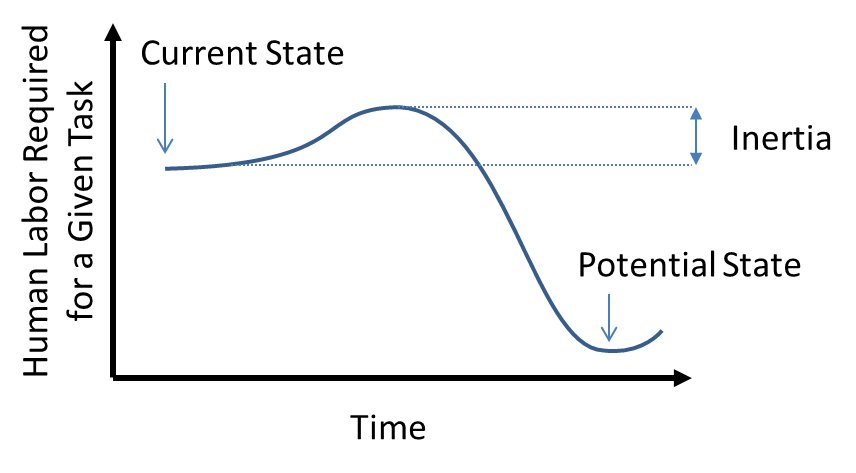
The established power structure has a tendency towards inertia if no strong impetus for change exists. Nonetheless, the established power structure can only swim against the current so long. People increasingly have their eyes open to the possibilities of technology. They can see how easy these things could really be, if some of these artificial inefficiencies were dissolves. They see the potential, and their frustration is growing. 

We are in the midst of a profound change from physical to digital storage of information. The physical storage of information may have once necessitated an army of human labour to process data; filling out endless forms and shuttling them from one place to another, but in the paradigm of digital information these tasks become trivial.

Most people today simply surrender themselves to filling and filing of paper as just a necessary part of modern life. They suppress their natural frustration, out of a good natured spirit of getting things done (and getting a pay check). Well I say, we should be frustrated. If necessity is the mother of invention then maybe frustration is the father. If we want to one day set aside mental toil as we did with physical toil, we will need energy to drive this change. We need to expect better if we want better.

Economic Reaction

Harnessing our collective frustration with mindless drudgery will be necessary to provide the energy to overcome the economic inertia which holds us back.

So embrace your frustration, it might just be what sets you free. 

Fuck Paperwork – Part 1: Fuck Paper

I fucking hate paperwork. I apologize for the profanity, but there is nothing in my life that more strongly elicits that visceral reaction: “It’s 2013 – why do I still have to do this?”. In this first of a two part post, I will deal with the physical sin of paperwork – the paper itself.

Why is any information still being sent to me in the form of scratchings on flattened plant fibre? I watched this ad about the future of paper this week, it’s a comedic ad and does well to point out a couple of niche areas where paper is unlikely to be replaced any time soon. Nonetheless, the ad has spurned me to think more critically about the role of paper in our society, and I have come to the following scientific conclusion: fuck paper.

Paper has been a key tool, and a convenient technology for the transmission of information, but it’s time has come and gone. Let’s enumerate the advantages of electronic documents over physical ones:

  1. Electronic documents are searchable – In 2013 if I have something that is not indexed and searchable, then it doesn’t exist. The amount of time I need to spend performing the nightmarish task of sifting through documents in meatspace is rapidly heading to 0. Yes, I am spending more time combing my email history for documents I need, but in this context 30 seconds spent searching my email feels like an arduous task. There is simply no comparison between electronic and physical documentation in this respect. 
  2. No physical clutter – It’s ridiculous to think about how much physical space is filled with documents that nobody will ever read. Even the modest amount of paper which I am obliged to keep on file feels like a lead anchor on my clean modern existence. 
  3. Less (wasted) human labour – So you are saying that they used to pay people just to fold paper and put it into envelopes?
  4. Vanishingly small likelihood of losing an electronic document – If you are taking appropriate steps to back up your documents online, there is really next to no chance of losing your files. To the less technologically savvy (of which I am sure, few read this blog) this is really as easy as emailing a document to yourself. Doom-sayers might worry about what will happen if electronic communication breaks down, but if the modern world were to experience such a catastrophe I am confident we would have much more important things to worry about then where we put our latest phone bill.
  5. Document security – Ok, this one might be arguable, but again, if you take appropriate measures to protect your electronic repositories then they should be less accessible to nefarious sorts then a physical document. You realize of course, that there is no inherent security built into a piece of paper; we must take steps to prevent people from accessing our physical documents. Doing so electronically, can be equally as effective.

Given all this, why does my electrical company insist on taking an electronic document, turning it into a physical one, then paying someone to deliver it across space and time to me? In my case, this is promptly followed by turning it back into an electronic document and destroying the physical one! What mode of insanity is this? I will admit that most billers are rapidly moving to a paperless system, but in my opinion, this can’t happen fast enough. The sin of physical paperwork gets more egregious with every passing day.

And even though billing might thankfully be going the way of the dinosaur, what is with the scraps of paper that get handed to me every time I buy a coffee? Why has no company figured this out yet? Yes, we would like to track our purchases, but paper is so utterly useless in this regard. Why do I have a wallet full of receipts for things that I might like to return?

Let me spell this out: why hasn’t an enterprising banking or credit card company created a means to automatically email electronic receipts? This could be relegated to a specialized account so as not to clog up your normal inbox. This solves both the problem of tracking expenses as well as keeping a proof of purchase on file. This is such an easy win for everyone: retailers use less paper, customers are happier, and we waste less paper. I am dumbfounded why it hasn’t happened yet.

But, but, what about my books!? Well, you can have your books. The use of paper for books really represents a minuscule amount of paper in the grand scheme. I am comfortable with my e-reader at this point, and the convenience of being able to download books outweighs any cons in my opinion. But, there is no need to rush to a complete eradication of all uses of paper, let’s just concentrate on the pointless and wasteful uses of paper.

Paper is an inefficient and archaic means of delivering information and should be cast out of our modern lives forever. The efficiency gap between paper and electronic documents is at least as wide as the gap between stone tablets and paper. Even disregarding the environmental cost of paper, the efficiency cost is enough to get upset about.  So next time you receive some stupid document printed on stupid paper, let yourself feel the anger; after all, it is 2013.